Archive
Microsoft is progressing quickly! – SkyDrive Pro updated to 25GB and improved sharing – via @BasvanKaam
I must say this once again, Microsoft looks to be on the right track when it comes to getting back as one strong supplier of services in the future/present “BYOD” world. As I wrote in my post #Microsoft – On the right track! – #Windows, #BYOD, #Citrix now Microsoft is actually targeting to solve many of the gaps that we see with today services for BYOx scenarios. For instance how to manage what you want on top of the device (Azure, Intune, SkyDrive, Work Folders etc…) in a controllable fashion and not a full managed device that costs you a fortune to manage… and ShareFile, Box and others are great solutions that have many features that SkyDrive doesn’t have. But there is one thing that they all lack (or please enlighten me!!):
Encryption at rest on Windows, OS X and Linux OS’s/distributions, here all providers are leaning on that you already have hard drive encryption like BitLocker etc. But who manages that then? Can you then say that your service is “BYOD-compliant”? I wouldn’t say so… It’s not only SmartPhones and Tablet devices that we loose… but here Microsoft and SkyDrive may be the first to come with encryption on at least Windows 8.1 devices and somewhat manageable…
But again back to the announcement from Microsoft and SkyDrive:
Microsoft announced today that it is giving business users more storage space and a better way to share files across multiple devices. As first reported by TechCrunch, through its SkyDrive Pro accounts, employees will now receive 25GB of storage to start out with, a sharp increase from 7GB — and even this capacity can be increased to 50GB or even 100GB. Additionally, using SkyDrive’s Shared with Me view, users can share files with their friends and co-workers securely and in real-time.
According to Microsoft Senior Product Managers Mark Kashman and Tejas Mehta, the new storage space limits will be available for both new and existing customers.
This certainly makes the service standout among its competitors, namely Dropbox and Box. It was only about a week or so ago when the latter heralded in the launch of a new pricing plan aiming to increase the number of small businesses using its service. For personal users, Box also wound up doubling the amount of free storage they received.
Here’s how you can figure out the overall storage for each user:
With Office 365, you get 25 GB of SkyDrive Pro storage + 25 GB of email storage + 5 GB for each site mailbox you create + your total available tenant storage, which for every Office 365 business customer starts at 10 GB + (500 MB x # of user(s)1).
While Dropbox, Box, and Hightail certainly are some of the popular services out there today, SkyDrive isn’t something to be trifled with either. Through its integration with the Surface, Windows Phone, and other Microsoft products, along with iOS and Android devices, it has the potential to be a very powerful service.
As for the new sharing feature, just like you would perhaps see in Google Drive or any other cloud storage service, SkyDrive Pro is now offering a Shared with Me view that lets you take a shared document and view, edit, re-share, download, and more — all as if it were in your own storage bin.

But Microsoft isn’t stopping there, as it is adding several minor, but interesting enhancements to SkyDrive. The company has also increased the overall file upload limit to its SharePoint Online service to 2GB per file. Files placed into the recycle bin will now remain…
Continue reading here!
//Richard
A look at Work Folders – #Microsoft, #WorkFolders, #MIM, #BYOD – via @STEALTHPUPPY
This is an interesting new feature by Microsoft. I’ve touched upon the topic in my earlier post: #Microsoft – On the right track! – #Windows, #BYOD, #Citrix
And here you have another good blog post from Aaron Parker around the topic!
Microsoft announced some interesting new features in Windows Server 2012 R2 at TechEd 2013 and one of those that piqued my interest is Work Folders. I’m not the biggest fan of Redirected Folders and Offline files, but it’s essentially the only enterprise solution Microsoft provides today for taking your data offline. Microsoft needs to provide a completely new method of syncing file data – one that is designed for todays use cases and computing environment.
Work Folders is a brand new direction for enabling access to data in offline scenarios, along the lines of Citrix ShareFile and Dropbox, but without the web and sharing features. Like most Microsoft OS features, Work Folders is tied to a specific release of Windows; however according to this Channel 9 video, Microsoft will release Work Folders for Windows 7, iOS and “other devices” (presumably Android). This is excellent news.
Here’s a short look at setting up and connecting to Work Folders using the preview releases of Windows Server 2012 R2 and Windows 8.1 – what’s version 1.0 going to deliver?
Server Configuration
For a more detailed walkthrough on deploying Work Folders, download this document: Windows Server 2012 R2: Enabling Windows Server Work Folders.
Work Folders is a component of the File and Storage Services role in Windows Server. I’ve installed Windows Server 2012 R2 into a virtual machine and am using local storage.

Once installed, Work Folders is managed through Server Manager:

Creating a new sync share is performed via a wizard which will first ask where the Sync Share will be located. This can be a new folder or an existing share – mixing user home drives and Work Folders should be possible. Note that at this time, Work Folders only supports providing users with exclusive access to Sync Share location – there is no provision for providing access to shared data. Read more…
Remote Desktop Services are now allowed on #Windows #Azure – #RDS, #TS, #XenDesktop
This is a great thing that you should have a look at and investigate how it would fit you and your organization! Finally Microsoft has changed the license model! They still have some work to be done on it though so we can run Virtual Desktops (VDI’s) as well!! 😉
Read this great blog post from lpanzano:
I’ve not seen a lot of news about this so I thought it was worth writing a short post just to remember everyone that on July 1st, Microsoft has officially changed Windows Azure licensing terms (PUR) to allow the use of Remote Desktop Services (RDS) on Windows Azure Virtual Machines. Previously this scenario was not allowed in Windows Azure. Before July 1st you could only access an Azure Windows Server VM for purpose of server administration or maintenance (up to 2 simultaneous sessions are authorized for this service).
Let’s see some details about this change:
-
To enable more than 2 simultaneous sessions you will need to purchase RDS Subscriber Access Licenses (SALs) through the Microsoft Services Provider Licensing Agreement (SPLA) for each user or device that will access your solution on Windows Azure. SPLA is separate from an Azure agreement and is contracted through an authorized SPLA reseller. Click here for more information about SPLA benefits and requirements.
-
RDS Client Access Licenses (CALs) purchased from Microsoft VL programs such as EA, do not get license mobility to shared cloud platforms, hence they cannot be used on Azure.
-
Windows ‘Client’ OS (e.g. Windows 8) virtual desktops, or VDI deployments, will continue to not be allowed on Azure, because Windows client OS product use rights prohibit such use on multi-tenant/shared cloud environments.
-
Customers can use 3rd party application hosting products that require RDS sessions functionality (e.g. Citrix XenDesktop), subject to product use terms set by those 3rd party providers, and provided these products leverage only RDS session-hosting (Terminal Services) functionality. Note that RDS SALs are still required when using these 3rd party products.
Continue reading this post here!
Citrix also created a good blog post on their view of the top 5 scenarios for putting XenDesktop on Azure:
Top 5 Scenarios for XenDesktop on Windows Azure
Since Windows Azure launched I have looked forward to the day Citrix would be able to work jointly with Microsoft to support XenDesktop and XenApp workloads. We are excited that today is the day we announce support for XenDesktop 7 and XenApp 6.5 on Windows Azure. Customers can now take advantage of the leading Citrix desktop virtualization solution and all of the HDX user experience goodness on Microsoft’s leading public cloud. With the announcement we’ve published two design guides (here andhere) to help get you started with your deployments.
#Microsoft – On the right track! – #Windows, #BYOD, #Citrix
I don’t know if you all agree but I find that Microsoft is making some really good strategic decisions to align themselves and be ready for the “next generation” workplace and client services. Everyone has been talking about BYOx and that everyone will bring their own device and consume business services and functions on that device in parallel to doing personal stuff.
But has BYOD taken off yet?
I personally think that it hasn’t to the extent that many thought it would, there are some companies in some countries that have adopted it for some use cases and user categories, but the majority is still struggling with it though their business apps and functions aren’t really there to support this way of working yet.
Even if they have a NetScaler or similar remote access capabilities with some sort of Desktop and App virtualization (like Citrix XenDesktop) to run the apps it’s still not enough. How do you solve the offline working scenario? And isn’t hosted apps and desktops just a legacy workaround until those business processes have been SaaS’ified? And what about “dropbox” alternatives, H: drives and G: drives, Sharepoint data etc. There is still a user data mess (read my earlier post on this) that needs to be solved and especially a “mega aggregator” tool for getting data/content and synch across devices in a secure manner (data also encrypted at rest on ALL devices and not just mobiles)…
Microsoft is kind of stepping up here I must say from a strategy point of view that makes me believe in them, even though I’ve said that no one ever will take my MacBook Air from me! Have a look at the features that are coming with Windows 8.1 to support a more “semi-controlled” or “semi-trusted” device, and the new cloud services like Azure AD, Windows Intunes offerings in combination with the online messaging and collaboration Office 365 services. And they are apparently also working on a “legacy” cloud service to offer desktops as a service (DaaS) as I wrote in a previous blog post as well.
I think that Microsoft is moving in the right direction towards offering the next generation enterprise IT services and to support the new way of working, and fast!
Have a look at these posts/articles on the news in Windows 8.1:
Everything you need, right from (the) Start
Microsoft is focused on delivering one experience across all the devices in your life. The centerpiece of that strategy and experience are the Microsoft services and apps that come right from (the) Start on your new Windows device.
This is the first blog post in a series that will highlight the apps and services driving toward this “one experience” vision. This experience comes to life through more than 20 new and improved Microsoft apps and services that come as part of Windows 8.1, including a new one that we are announcing today – Skype, right from (the) Start!

It’s where you want to go today….
Upgrading to #Citrix #Receiver for #Windows – why and how?
This is something that all Citrix admins should read! How many questions don’t U get about which version of the client to use and why etc?
This document describes the various versions of Receivers for Windows, lists the reasons for upgrading, and recommends best practices for upgrading to the latest version of Receiver based on specific circumstances.
Note: The Online Plug-in 12.x will reach end of its maintenance in March 2013. Customers using Online Plug-in with XenApp 5, XenApp 6.x, XenDesktop 4.x, or XenDesktop 5.x must upgrade to the latest version of Receiver for Windows 3.X prior to that date where practical.
Citrix Receiver is the latest Citrix software you install on Windows end points to gain access to virtualized apps and desktops. It is also regularly installed on virtual desktops to enable access to virtualized apps.
The name of Citrix client software and the built-in functions are changed over the years. The clients in common use today are the Online Plug-in for Windows 12.X and the Receiver for Windows 3.X.

Where the Online Plug-in for Windows 12.X provided Web and PNAgent support, Receiver for Windows 3.X provides additional support. It can be configured for self-service access to applications, VPN-less remote access, single sign-on the Windows, Web, and SaaS applications, and has a built-in method to check for updates.
Both the Online Plug-in and Receiver have two versions.
- The Online Plug-in Web is used solely for Web access to applications and the Online Plug-in (Full) supports Web access as well as PNA Services. The Full version supported SSO, Smart Cards, and access to apps through the Start menu
The standard Receiver for Windows, CitrixReceiver.exe, can be considered is a complete replacement for the Online Plug-in Web and largely a replacement for the Online Plug-in (Full). It can be used for web access. It can be configured to access PNA Services. And it can also be used with the latest versions of StoreFront, CloudGateway (App Controller), and Access Gateway to provide a rich set of services. It contains the latest, multithread, multi-stream HDX engine.

#XenDesktop 7 and #AppController setup – #Citrix, #MAM – via @msandbu
Good job on this blog post by Marius Sandbu!
XenDesktop 7 setup and AppController setup
So the big day is here, XenDesktop 7 is released from Citrix and with it ends the old XenApp architecture.
Support for Server based session hosts is still there but the architecture is merged into XenDesktop.
Other features include:
App-V integration
License console integrated into Studio
Storefront administration also from the same console.
The list goes on and pictures say more than a thousand words.
(Can also say that Citrix also released a new version of the Receiver platform for both Mac and Windows today, which includes support for XenDesktop 7 and Storefront.
http://blogs.citrix.com/2013/06/25/receiver-for-windows-4-0-released-today/
http://blogs.citrix.com/2013/06/25/whats-new-with-receiver-for-mac-11-8/
XenDesktop 7 can be downloaded from Mycitrix.com à
http://www.citrix.com/downloads/xendesktop.html
Now the installation is pretty straight forward just choose Standard delivery controller install and it will include all of the needed components. After they are installed we need to create a deployment.
When you start Desktop Studio we choose create new deployment.

So we create a new site…
Continue reading here!
//Richard
#BYOD + #Messaging + #Collaboration + #Data securely = How??
Yes, how do you solve this?
I’m running into this topic lately with a lot of people and customers….
It’s around the whole BYOD and unmanaged devices and how useful they are in an enterprise world and all the capabilities and way of working that you’re used to in a secure and still cost effective way (and let’s not forget in a USER FRIENDLY way)!
One question that I’ve not yet found an answer to is:
How do we have all offline capabilities needed for an “Office” worker on a BYOD in our enterprise landscape? How do we ensure that you can use our Messaging, Collaboration and Data/Info services on this totally unmanaged device in a SECURE way?
This is a tough challenge! I guess that most of your users are used to using the Office suite locally on their managed device where they can use Outlook offline, work with data/files in Excel and Word etc offline. But what happens if you tell them to use an unmanaged device or their own personal device of their choice?
All of a sudden there is no real good way of providing them with offline messaging and collaboration (Outlook Anywhere and Lync for instance) capabilities in a secure manner. This BYOD/unmanaged device is not a part of your AD, you have no control and cannot enforce anything! So Outlook that is installed on it may use your Outlook Anywhere service but then its data sits on that unmanaged device unencrypted and unsecured!
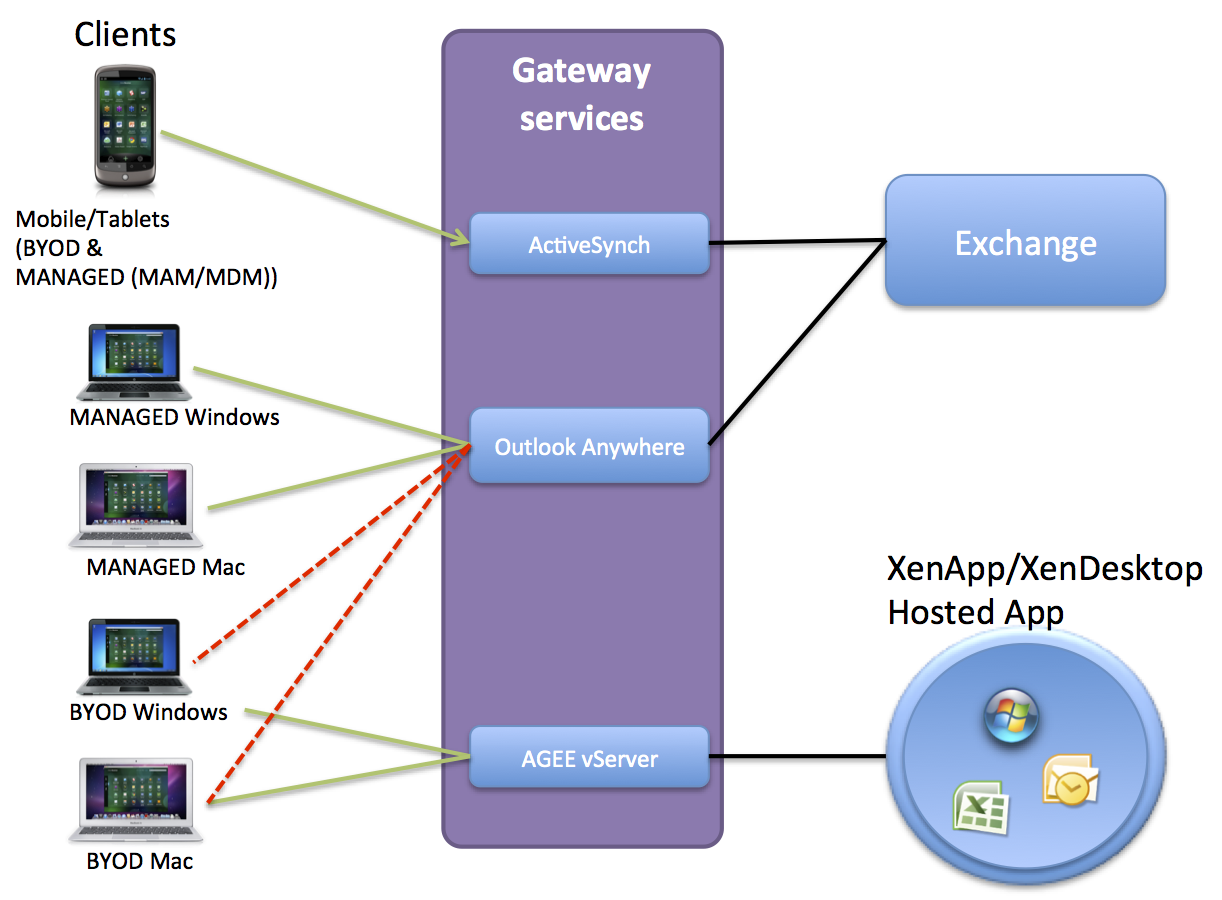
Think of the picture above (yes I know it’s a mess but I just want to illustrate the issue), you have BYOD devices that are running Windows 7, XP, 8 etc and also Mac OS X. What if you open up your Outlook anywhere service to those devices, then all your emails etc. will be unsecured on them!
Citrix and others are focusing on providing this email capability in a secure manner on all mobile OS’s like iOS and Android etc through it’s Citrix Worx apps for mail and also the newly announced Hosted MobileMail. But these are more or less just targeted against mobile devices (smartphones and tablets), but what about the standard laptop users!?!?! They need something as well!
And Windows RMS and other solutions just wont fit very well here… Citrix XenVault was something that could have worked to enable offline support for corporate Messaging services but it’s not there… I’d like to run corporate apps locally on the device offline in a secure and controllable container!!
The same issue you have with Data!!!
ShareFile doesn’t support encryption on Windows or OS X!!!
But it does on mobile devices.. I guess you have to trust your users and BYOD devices that they are encrypted using BitLocker or FileVault etc…. but can you?
So please enlighten me here what the missing puzzle piece is!! Because I have a hard time taking away a managed device form a user and tell them that they on their BYOD device HAVE TO BE ONLINE TO WORK! It’s a step back from a usability and productiveness point of view… but it may be a cost saver though… but is a BYOD/unmanaged device and a VDI or Hosted Shared Desktop always a good option to provide business apps to that laptop? NO! I guess everyone have understood that making business apps and functions web-based or mobile app based is good and a lot of focus is there, but we cannot forget the traditional productive device that the laptop is!
If you know the magic solution to these challenges please let me know! 🙂
Cheers!
//Richard
WOW! – MS readies ‘Mohoro’ Windows desktop as a service – #BYOD, #DaaS – via @brianmadden
What can you say!?!? It wouldn’t surprise me a bit!! Of course Microsoft would come out with an Azure based cloud offerings of Desktops as a Service! I will follow this progress for sure, interesting and NOT so nice for quite a number of partners out there…
Summary: Microsoft is believed to be building a Windows Azure-hosted desktop virtualization service that could be available on a pay-per-use basis.
In yet another example of its growing emphasis on remaking itself as a devices and services company, Microsoft looks to be developing a pay-per-use “Windows desktop as a service” that will run on Windows Azure.

The desktop virtualization service, codenamed Mohoro, is in a very early development phase, from what I’ve heard from sources. I don’t know the final launch target, but I wouldn’t be surprised if it isn’t until the second half of 2014.
Mohoro is a town located on the island of Grande Comore in the Comoros Islands in the Indian Ocean. Given that members of the Microsoft India Development Center may be playing a key role in Mohoro’s development, according to my sources, the codename choice seems appropriate.
Microsoft owns the Mohoro.com and Mohoro.Net domain names.
Mohoro, like another Windows service, Windows Intune, is a product of Microsoft’s Server and Tools unit, I hear. Windows Intune is still not yet hosted on Windows Azure (as far as I know), but supposedly the plan is to move it to Azure at some point. Windows Intune already does make use of Windows Azure Active Directory as its directory and authentication service.
The same way that Windows Intune is the cloud complement to System Center, Mohoro seems to be the cloud version of Remote Desktop/Remote App.
This is like “Remote App as a hosted service,” said one of my contacts. It could be for companies who want thin clients or to run legacy apps on new PCs. Right now, companies have to have their own servers in the equation to do this, but “with Mohoro, you click a few buttons, deploy your apps, use Intune to push out configuration to all of your company’s devices, and you’re done,” my contact added.
Microsoft currently offers multiple ways for users to access their Windows desktops remotely via different virtualization technologies and products.
The aforementioned Remote App/Remote Desktop allows Windows users to connect to a remote Windows PC and access resources from it. On the Windows RT front, given that operating system’s restrictions on use of almost any existing Win32 applications, Remote Desktop provides a way for users to continue to use apps they already have on new hardware like the Microsoft Surface RT. Licensing of Remote Desktop and Remote Desktop Services is complex, however, and requires access to server infrastructure on the back-end.
Currently, it is not possible under Microsoft’s licensing terms to run Windows client in virtual machines hosted on Windows Azure. (The new Azure VMs do allow…
Continue to read this great blog post by Mary Jo Foley here!
//Richard
#Windows #Azure Active Directory steps out of the shadows
I’ve blogged about this release before with some info but here is another good article about how it can assist you in managing user authentication in the cloud.
Microsoft recently announced the general availability of Windows Azure Active Directory, a cloud-based service that lets admins manage multiple user identities and access. Although it’s been lurking in the background of other Microsoft products for some time — and still requires work to make it a fully useful tool — it’s a step in the right direction.
At its core, Windows Azure Active Directory is essentially a copy of Active Directory held in the cloud that provides basic authorization and authentication when users access cloud services. Ideally, admins use it to centralize the database of authorized users for cloud services, which then lets them authorize employees and contractors to work in certain applications. This allowance includes both Microsoft and third-party applications that accept authentication through common industry standards.
Through synchronization with an on-premises Active Directory deployment, you can also deploy single sign-on, so users don’t have to remember multiple passwords or enter them more than once to access cloud applications. More importantly, it provides a better way to remove access to cloud services for users who have left the company — a previous weak link in the cloud identity management story.
Windows Azure Active Directory: Not exactly new
True to Microsoft’s history of dogfooding its own products, Windows Azure Active Directory had been in use for nearly a year before its current general release. Few actually knew that all Office 365 accounts have been using a preview release of Windows Azure Active Directory for some time. Users of the general Windows Azure service, Dynamics CRM andWindows Intune also have their details stored in private Windows Azure Active Directory accounts.
According to Microsoft, since just after the beginning of the 2013 calendar year, “Windows Azure AD has processed over 65 billion authentication requests while maintaining 99.97% or better monthly availability.” Windows Azure Active Directory is a distributed service running across 14 of Microsoft’s data centers all over the globe.
User interface improvements
One improvement that happened between the preview release of Windows Azure Active Directory and the Web version release is the user interface, which was basically nonexistent before. Now you can access a clean section of the modern-looking Windows Azure control panel to create and manage instances of Windows Azure Active Directory (Figure 1).

You can add these instances to your Windows Azure subscription by logging into your Microsoft account, which…
Continue reading here!
//Richard


 The IT Melting Pot!