Archive
Top 5 #Citrix #XenServer Questions from the Citrix Master Class
Below are the top 5 XenServer questions raised from the Citrix Master Class posted by Amanda Saunders!
Let’s face it, XenServer has been around for quite a while. Citrix purchased the hypervisor back in 2007 and released it entirely free to the market in 2009. Since then, we’ve seen over 1 million downloads of the product and mass adoption in all sorts of businesses from SMBs to the largest service providers. Despite all this, we had almost 700 first time attendees on our XenServer Master Class last week taking a look at what this product has to offer. The newbies were joined by 300 additional Master Class veterans who continue to return to see what we’ll be showing off this time on our British radio show inspired, tech webinar. All of the attendees joined in to keep us busy, asking hundreds of questions for our XenServer experts to answer live on the webinar. If you missed it, watch the recording and read a summary of the top questions asked by the audience.
Why are cloud providers choosing XenServer to power their clouds?
This question could have an entire blog post dedicated to it, but I will try to address it as simply as possible. Currently 80% of Citrix CloudPlatform and Apache CloudStack environments are built on top of Xen or XenServer. Why? The high level reasons are scalability and cost*.
Scalability comes from XenServer’s fully replicated architecture across all hosts in an environment. This means there is no management server required to manage a given number of hosts. Should the master host in a pool go down, any other host can be promoted to replace it with no loss of functionality or configuration. In practice, this means cloud providers can freely choose to cluster hosts as required without incurring any additional configuration or management complexity based on cluster size.
While cost is an important factor for every company to consider, it is particularly important when you’re looking at licensing hundreds or even thousands of hosts. Both the open source version of XenServer and the premium version of XenServer that is included as part of your CloudPlatform entitlement, mean cloud providers can get the virtualization layer of their cloud at no cost. These savings can then be turned into additional differentiated service offerings or added savings to their end user.
*other reasons include open source base, flexibility, VM density and tenant isolation.
 XenMotion, what is it and is it free?
We have a competitor in the space who likes to use “v” in a lot of their feature names. A good rule of thumb to find the corresponding feature in XenServer is to replace “v” with “Xen”. XenMotion is our live migration feature that allows you to move VMs from one host in a pool to another provided that the pool has shared storage attached. This has been available in our free version since 2009.
Storage XenMotion is a brand new feature that we released with XenServer 6.1. This feature enables you to move VMs between hosts without the requirement of shared storage which lessens the hardware requirement/expense for both cloud providers using commodity hardware and SMBs with smaller environments. Storage XenMotion is available in our advanced version of XenServer.
Is there an easy way to get support for my environment, even if I’m running on free?
For those of you running a premium edition of XenServer (Advanced, Enterprise and Platinum) we recently changed our support model to offer unlimited, 24×7 support for paid editions of XenServer at about 7% of license cost. What does this mean to the free users out there? Well, it means you can no longer purchase support from Citrix for your XenServer environment. That being said, in addition to the incredible support you can get on the forums, we’ve also introduced a new Citrix Auto Support tool that can do a sanity check of your environment. Simply upload a log file and we’ll check for any issues that we recognize including missing patches, known bugs or configuration errors. This tool can be used for both free or paid editions, so try it out for yourself at http://taas.citrix.com.
What is MonitorIT?

A big thank you to our friends at Goliath Technologies who demoed their brand new version of MonitorIT on our XenServer Master Class. This solution delivers proactive monitoring of your entire environment right out of XenCenter or directly from a browser. What do we mean by “entire environment”? Virtual servers, physical servers, VDI, applications, databases, log management, network, storage, data center components, workstations – EVERYTHING! Do you have multiple hypervisors in your environment? Monitor your vSphere clusters straight from your XenCenter console using this product. You can go one step further and have MonitorIT proactively make changes to alleviate bottlenecks in your environment so the business can keep doing business without interruption. Don’t take my word for it, check out their free trial for yourself. They’ve even opened up their early access program so you can access all the great new features that…
Continue reading here!
//Richard
#Citrix #XenServer Multiple Security Updates released
Severity: Medium
Description of Problem
A number of security vulnerabilities have been identified in Citrix XenServer. These vulnerabilities affect all currently supported versions of Citrix XenServer up to and including version 6.1.
The following vulnerabilities have been addressed:
• interrupt remap entries shared and old ones not cleared on AMD IOMMUs (CVE-2013-0153)
• oxenstored incorrect handling of certain Xenbus ring states (CVE-2013-0215)
• Linux netback DoS via malicious guest ring (CVE-2013-0216, CVE-2013-0217)
• Linux pciback DoS via not rate limited log messages (CVE-2013-0231)
What Customers Should Do
Hotfixes have been released to address these issues in all supported versions and update levels of Citrix XenServer. Citrix recommends that customers using Citrix XenServer identify and apply all the hotfixes that relate to their deployed versions.
Customers using XenServer with AMD CPUs that pass through PCI devices (e.g. using the GPU passthrough feature) should review the hotfix release notes below for more information relevant to their specific deployments.
Continue reading and download updates here!
//Richard
Do you really need a #BYOD policy? – via @GeneMarks
This is a really good article by Gene Marks!
Social media. Cloud computing. Gamification. SaaS. Social CRM. Virtualization. Mobile. Every year we hear of the latest technology issues facing small business owners like me. And now it’s BYOD (Bring Your Own Device). Everywhere I read in the tech world it’s BYOD. That’s because with the proliferation of smartphones, tablets and mini-laptops it’s become the hot tech security issue. Whitepapers are written. Seminars are conducted. Roundtables are moderated. It’s a BYOD year.
I have 10 people in my company. And a half dozen other contractors. These people are using smartphones, tablets and laptops to access our data. We do not have a BYOD policy. Do I really need one? Do all businesses, big or small, need to really worry about this? Or is just another scare tactic from a bunch of IT guys looking to put fear into their clients’ minds and generate additional billable hours.
Hmmm.
The fact that everyone in my company has a different smartphone is of no concern to me. Why should I care if Sam prefers his iPhone but Josh likes his Droid? They are using their phones to call clients on Verizon or AT&T or whatever so I’m not exposed to any risk there. The same with texting. But uh oh…then there’s email. Am I exposed to security issues when they send and retrieve email from our server? No. That’s because we have a hosted mail server and each employee has their own login to their email account. They set up their email on their own with instructions we gave them. Viruses, spam and all the other evil things that could happen via email are (hopefully) controlled by the security software running at the server level.
#Citrix #AppController 2.6 released as part of #MobileSolutions #Bundle #BYOD
As a part of the Mobile Solutions Bundle that now is available on MyCitrix you can find a new version of AppController.
AppController 2.6 supports the following new features:
- Certificate support. When you configure AppController for the first time in the web-based management console, you can add or create certificates on the Active Directory settings page.
- Microsoft Hyper-V support. You can install the AppController 2.6 virtual machine on Windows Server 2012 with Hyper-V enabled or on Microsoft Hyper-V Server 2012.
- Migration support to AppController 2.6. You can upgrade to AppController 2.6 from AppController 2.0 or from AppController 2.5.
- Mobile store support. You can upload mobile apps from the Apple App Store or Google Play to AppController. You can use the Citrix App Preparation Tool to wrap iOS and Android apps from the Apple App Store or Google Play. When you wrap the app, you can secure access and enforce policies. When you upload the app to AppController, you can configure the policies. You can also upload an app from the App Store or Google Play to AppController without using the App Preparation Tool.
- Secure connections to Active Directory. You can configure secure connections to Active Directory when you configure AppController 2.6 for the first time.
- ShareFile updates. In previous AppController versions, when you configured ShareFile, the domain sharefile.com was automatically appended to the domain name. In this release, the domain sharefile.com does not automatically append to the ShareFile domain name. You must enter the entire ShareFile domain name.
- Support for mobile links. You can configure mobile links to retrieve the name and description of apps automatically from the Apple App Store. For apps available through the Google Play Store, you enter the name, description and URL of the app. When you configure mobile links, links appear in Receiver with the Play Store or App Store name.
- Web proxy user name format. When you configure the web proxy, you can use either the SAMAccount format or the User Principal Name (UPN) as the user name.
Read more about it here!
//Richard
#XenMobile, #MobileSolutions – Is this what we’ve been waiting for? – #Citrix, #ZenPrise, #BYOD
Ok, so Citrix has now presented their new offering after merging Zenprise into their product portfolio. And is this what you have been waiting for?
My personal answer to that is probably yes, now you have all the capabilities (almost) out there to get your BYOx program/strategy and architecture in place or if you just want to add additional capabilities to your existing service offerings.
I must say though that the packaging is compelling and VERY interesting!
Citrix Mobile Solutions Bundle
The Citrix Mobile Solutions Bundle, which is comprised of XenMobile MDMand CloudGateway, offers a complete enterprise mobility management solution that enables IT to manage and secure devices, apps, and data.
XenMobile MDM Edition
XenMobile MDM Edition offers market leading mobile device management capabilities that deliver role-based management, configuration and security of corporate and employee-owned devices.
What I’d like to see is a roadmap where Citrix becomes an even more complete provider of technology in the Mobility segment. I still believe that Mobility is not only about smartphones and tablets and all the apps that you shall deliver to those devices and non-managed and non-corporate owned devices. There is still a need to provide device management of corporate assets that are not smartphones and tablets! And why should you have to implement another device management service/product for those.
So please Citrix = add Windows 7/8, OS X and Linux device capabilities as well in your almost complete Enterprise Mobile Management offering!
The offering is of course also today an early release where the former Zenprise product and CloudGateway is provided under the same marketing and price bundle but I’m waiting for when we have one (1) enterprise app store! And all capabilities from one technical architecture and product that you enable each capability on a need basis and are licensed accordingly.
But this is a great step for Citrix and I must say that I’m looking forward to see where this is going, I mean the feature set is pretty awesome!
Compare Features |
XenMobile MDM Edition |
Mobile Solutions Bundle |
| Enterprise MDM | ||
| Device management |  |
|
| Configure policies | |
|
| Security and compliance | |
|
| Scalability and high-availability | |
|
| Ease of administration | |
|
| Provisioning and self-service enrollment | |
|
| Enterprise integration | |
|
| Monitor and support | |
|
| Decommission devices | |
|
| Secure email, browser and data sharing apps | ||
| @WorkMail | |
|
| Email attachment encryption | |
|
| @WorkWeb | |
|
| ShareFile integration | |
|
| Microsoft SharePoint integration | |
|
| Mobile app containers | ||
| Mobile application management | |
|
| MDX Vault | |
|
| MDX Interapp | |
|
| MDX Access | |
|
| App wrapping | |
|
| Unified app store | ||
| Enterprise app store | |
|
| Follow-me apps | |
|
| Identity management, single sign-on and scenario-based access control | ||
| Active Directory integration | |
|
| Instant application and data provisioning | |
|
| Single sign-on to apps and data | |
|
| App requests | |
|
| Instant application and data de-provisioning | |
|
| Strong authentication | |
|
| Secure remote access | |
|
| Policy enforcement | |
|
More information about the technologies have also been added to eDocs!

Of course also made their competition table:
Compare the Mobile Solutions Bundle to other enterprise mobility solutions
These are exciting times and I’m looking forward to play around with the whole bundle!
Read more about XenMobile/Mobile Solutions here!
//Richard
#Citrix #Receiver 5.7.1 for iOS released
Ok, another version of Citrix Receiver released!
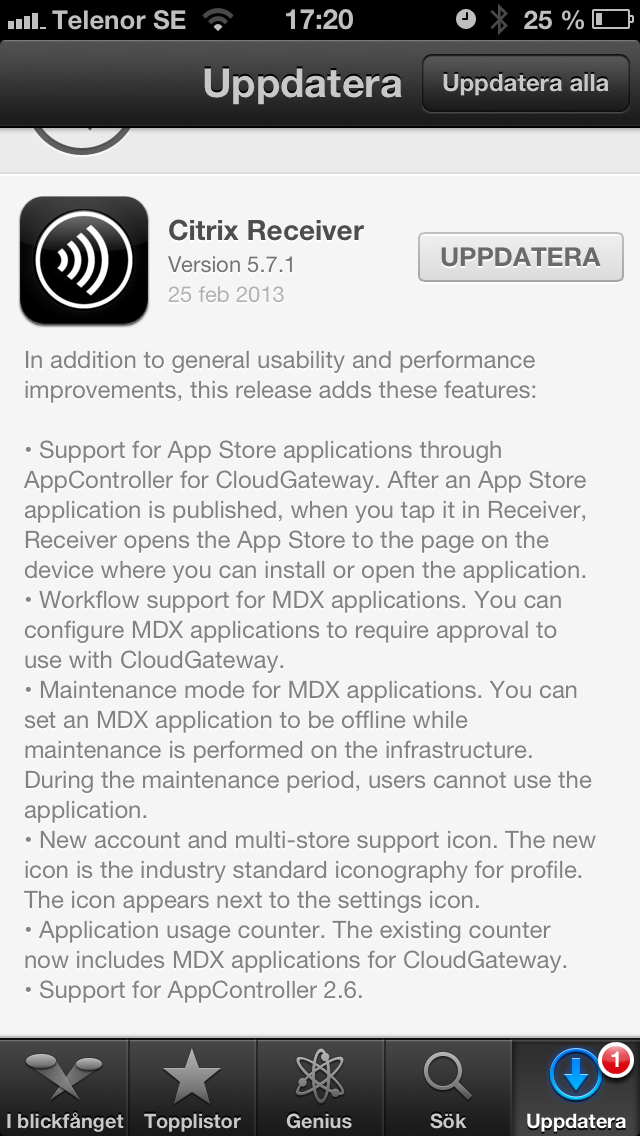
Read more about it here (no detailed 5.7.1 info yet but I guess it’s coming soon)!
//Richard
February Edition of #Citrix #XenDesktop Technical Newsletter Now Available
February XenDesktop newsletter is out! Here’s a subset of what you can read from the Citrix blog post.
Using XenDesktop? Then you need to get the XenDesktop Technical Newsletter! The newsletter is comprised of the best technical resources from across Citrix Services: Consulting, Technical Support, Education, and Technical Readiness. In its third year the newsletter is designed to help customers run their XenDesktop optimally and get more out of their investment in Citrix desktop virtualization. And its FREE!
I am pleased to announce that the February 2013 edition of the newsletter is now available.
Check out the archive page, where you can access both the current and past issues, as well as subscribe to the FREE monthly newsletter.
The February edition of the newsletter is packed with great content, including:
- Optimal XenApp 6.5 VM Configuration (Blog)
- Introduction to the new Project Accelerator (Blog)
- Deploying XenApp 6.5 using PVS (Blog)
- Insider Troubleshooting tips for Administrators (eBook)
- Whats new with Excalibur (Blog)
- Top Knowledge Center content for December 2012 (Articles, hotfixes, whitepapers, etc…)
- How to configure Access Gateway 5 standalone for use with XD5 (tech note)
- XenDesktop Tools & Hotfixes
- And much more.
If you have any feedback/suggestions please let us know. Also don’t forget to Sign-up now!
//Richard
It all ADDS up with #BYOD (Assess + Design + Deploy + Support = Success)
Below you can read about a couple of webinars coming up on Citrix’s view on how to get your BYOD strategy up and running!
Cowboy consumerization is here…and it’s here to stay. You may not want to admit it, but you already have a few “outlaws” in your organization who are using their own devices, regardless of whether you allow them to or not. In fact, you probably have entire departments accessing email, apps and data on devices and through services that are not secure. The consumerization of IT is here to stay, so you may as well embrace it.
 When business information is accessed by user-owned, consumer-grade devices, the right technology foundation is essential to ensure IT control. The question is where to begin. What are the business, user and IT benefits of enabling bring-your-own device (BYOD)?
The business wants to make employees more productive yet remain compliant. Users want access to all their enterprise apps and data from their many devices and IT wants to ensure security and control in a way that’s simple to manage.
Before you begin a BYOD initiative, it’s important to understand the underlying products that will become a part of your BYOD solution and their functionality and feature sets. One size does not fit all and, even though a BYOD solution may seem complex, it’s important to realize that it all boils down to addressing four key things:
- Multiple Devices – Employees are bringing their own devices (on average 3) into the workplace – whether you like it or not.
- Lots of Apps – IT have lots of them and different types (Windows, Web, SaaS and Mobile) that everyone want access to from their device.
- Unmanaged Data – Employees are..
Continue reading here!
//Richard
#Citrix #NetScaler Insight (NI) – Citrix TV videos
Citrix has released some videos related to NetScaler Insight. Have a look at them and try it out!
Setting up NetScaler Insight 1.0
NetScaler Insight – Adding NetScaler Instances to NetScaler Insight
Application visibility using NetScaler Insight
NetScaler Insight – Adding NetScaler Instances to NetScaler Insight
Cheers!
//Richard
#Citrix #AppController 2.5 Implementation Tips – #CloudGateway, #BYOD
Great blog post by Matthew Brooks!
AppController is a component of the Citrix CloudGateway Enterprise suite that orchestrates access to Enterprise Cloud applications. Those applications may take many forms including Mobile Applications, Software-as-a-Service hosted in public clouds, and Web links. Below I provided some tips to help with the implementation of AppController 2.5 (which is the latest version as of the publishing of this blog).
System Related
Including settings such as the Hostname, SSL certificates, and Restore.
TIPs:
- Take a hypervisor level snapshot after the initial installation so that you can easily return to that base level if configuration or integrations efforts go awry.
- The hostname cannot contain special characters in the AppController certificate signing request.
- The hostname must match SSL certificate.
- The system cert must be chained to its CA/(s).
Active Directory Related
Including settings such as the Server (Domain Controller), Base DN, and Service Account credentials.
TIPs:
- The AppController only supports integration with a single domain. Multiple domains require multiple AppControllers. The NetScaler Access Gateway may be configured to allow users to access a single fully qualified domain name, yet be directed to their respective domain AppController through the use of Global Groups. See CTX116169 for more informationhttp://support.citrix.com/article/CTX116169
- All user accounts must have a first name, last name, and email address configured or they will receive an authorization error when attempting to launch applications. The bind Administrator account must also have email address configured or directory integration will fail.
- Only LDAP (TCP 389) may be configured through the wizard that must be completed initially. Thereafter LDAPS (TCP 636) may be configured through the full administration menu.
- If the server name domain name is a load balanced DNS entry the initial import may work, yet subsequent bind attempts will fail. Alternatively you may use the IP address of an LDAPS load balancer on a Netscaler with specific domain controllers configured as services. See CTX135092 for more information http://support.citrix.com/article/CTX135092
Network Related
Including settings such as the IP address, @Workweb and NTP server.
TIPs:
- Use IP private addresses as system addresses if possible. When Trust Settings are configured for NetScaler Access Gateway it does not allow SSO to public addresses. If public addresses must be used the NetScaler may be configured with an SSL Bridge to access the AppController. See NetScaler Traffic Management document for more information.
- NTP must be configured or SAML authentication may fail for SaaS sites if the time difference is significant.
- When Trust Settings are configured for NetScaler Access…
Continue reading here!
//Richard


 The IT Melting Pot!