Archive
Ten websites that teach coding and a bunch of other things – via @caleweissman
This is a great summary blog post with many good references to where you can start learning to code!
Seemingly every day there’s a new article or blog post imploring you to learn how to code. “Those who code have the power to transform their dreams into reality.” “Coding will help you keep [your job], or help you make a case for a raise.” “You should learn to program because it’s easy, it’s fun, it will increase your skill set, and… it will fundamentally change your perspective on the world.” What’s more, “If you want to start a technology company, you should learn to code.” New York City Mayor Michael Bloomberg’s New Year’s resolution was to learn how to code. Douglas Rushkoff, who calls coding “the new literacy of the digital age,” wrote an entire book about it. And didn’t Marc Andreessen say that “software is eating the world?” As a result, companies from Codecademy to edx and many others have popped up to meet this rising demand.
As a person who’s grown up in the digital age, I have often heard the cry, “digital literacy or die.” Conventional wisdom – at least today – is that in the way you know how to read and write English, “you need to have some understanding of the code that builds the Web… It is fundamental to the way the world is organized and the way people think about things these days.” If you buy that then you’ll want to start now.
But where should you go? I’ve been dabbling in the black arts, although I am by no means a ninja coder, and am ready to report back. The courses below offer everything from HTML to Python and beyond. HTML and CSS are good, because they’re the basic building blocks of Web design, and in my opinion, Python is useful, because it’s the most universal in many respects. Others say Java is better to learn, because its so prominent on the Web. I would rebut that you can learn Java from Python. Potayto. Potahto.
In any case, each program below emphasizes different pedagogical techniques and philosophies, and they are all mass market in the sense that anyone is welcome. No previous experience is necessary.
MIT Courseware Online
MIT has long been a pioneer of online courseware. One course is their Intro to Computer Science & Programming class, thought by many to be the best, most encompassing intro computing course offered. Taught by tenured MIT faculty, the online course is structured via taped lectures, written assignments, and self-assessment quizzes.
The course itself is quite rigorous as it was an intro course for MIT students. This isn’t a sort of online class you can do some parts and not the other. It requires a certain amount of pre-existing math knowhow to be truly successful. The course description says it only requires high school algebra as a prerequisite but I don’t buy this. I remember being pretty stumped by the second assignment, and I passed AP Calc with flying colors. This doesn’t mean the math is terribly high-level, but that it probably requires a certain amount of mathematical aptitude beyond algebra unless you want to spend the entire course scouring forums for help. As with any MIT course, there is an expectation that you not only know how to do a function, but why that function is performed and from where it stemmed. After attempting to follow this courseware for two sessions, I was officially stumped and dropped it.
edX
MIT and Harvard partnered up to create edX. It is a conglomeration of all of their available open courseware, along with a new department for the two institutions to perform research about the future of online courses and new pedagogical technologies. For MIT courseware, you can watch the lectures anytime, read the assignments, and self-assess. EdX has you follow the course in real time and complete the assignments and exams to receive a physical certificate from the program. It currently offers numerous classes in more subjects than just coding and far beyond the purview of Computers Science….
Continue reading here!
//Richard
#HP Improves Enterprise #Mobility with Cloud-based Management Solution
Interesting…
PALO ALTO, Calif. — HP Enterprise Services today announced a cloud-based management solution that delivers secure anytime, anywhere access to applications and data from any mobile device.
HP Enterprise Cloud Services – Mobility meets the demands of balancing the responsibilities and requirements of IT with the challenges and expectations of users. This new cloud solution is part of the HP Converged Cloud portfolio, which provides enterprises with the essential foundation of technologies and services to confidently build, operate and consume IT services.
The new solution provides fast and flexible deployment of tools and services for secure application access, file storage and sharing via multiple mobile platforms and all types of devices, including tablets and mobile phones. IT organizations are provided the tools to set appropriate security policies and the access controls to protect valuable corporate assets, applications and data.
The solution also allows users to download approved enterprise applications from a secure storefront, upload files to support collaboration and synchronize files between the HP cloud infrastructure and any mobile device. Mobile data is encrypted in transit and at rest, covering the device as well as the cloud infrastructure.
HP Enterprise Cloud Services – Mobility also provides the ability to configure cloud file storage that can scale up and down, and offers local storage options that address data sovereignty and compliance requirements.
“Mobility in the workplace continues to be a key focus and concern for IT executives,” said Pete Karolczak, senior vice president, HP Enterprise Services. “HP Enterprise Cloud Services – Mobility leverages HP’s strong cloud portfolio by providing clients with a mobility service that provides the highest level of user experience and productivity while minimizing risk for IT.”
HP Enterprise Cloud Services – Mobility integrates leading industry technologies, including solutions from Citrix and SAP, which are fully managed and maintained by HP to simplify deployment and ongoing operations.
Pricing and availability
HP Enterprise Cloud Services – Mobility is available globally with a set of service features and options priced and packaged to deliver…
Continue reading here!
//Richard
Enterprise Mobility Report – Lessons from the Mobile Cloud – #Citrix, #BYOD
Here is a good report done by Citrix, not that much that I didn’t expect but great to get some input!
We just released our quarterly enterprise mobility cloud report. Every quarter, we look out across our enterprise mobility customers deployed in the cloud and try to understand common practices by reviewing aggregate data on deployed apps, app blacklisting and whitelisting practices, policy deployments, and OS deployments by region and vertical industry. So here’s a small taste of what we saw in Q412.
Things we expected:
- iOS led in the enterprise. Definitely something we already knew.
- Industries like retail and restaurants – whose use cases involve direct one-on-one customer engagement, were iOS- (and iPad-) heavy. Makes sense.
- Industries with mobile field service organizations went for Android. Given the platform’s lower replacement cost, control-ability, and ubiquity, that makes sense.
- Facebook and Dropbox made the blacklist. Productivity and data security are major concerns, especially for corporate-issued devices.
Things we didn’t expect:
- Android gained in EMEA. Android gained eleven percentage points in Europe, the Middle East, and Africa in a quarter. Anecdotally, we know several organizations there that deployed big Android-based mobile line-of-business initiatives last quarter, but is there a bigger trend? Tell us what you think!
- Healthcare went for Android. 85% of deployed devices in our cloud in healthcare were Android. But healthcare organizations we talk to are standardizing on iOS, so it doesn’t add up! But remember: this is the cloud report. Most of our large healthcare customers have deployed our solution on-premise and those seem to be mostly iOS today. The cloud healthcare companies are really mobile themselves – usually home healthcare organizations like traveling nurses and therapists and hospice care workers who deliver end of life care to patients in their homes. It makes sense that these organizations would be big users of the cloud given the highly distributed nature of the business and the fact that there are some common HIPAA-compliant mobile apps that have developed for the Android platform.
- Dropbox was on the blacklist, but was also one of the most heavily-recommended apps from enterprise IT (in the enterprise app catalog). This juxtaposition speaks to Dropbox’s simultaneous usefulness and risk! Organizations can’t decide! Many of our customers talk to us about the “Dropbox dilemma” and most agree that if they could provide data sharing in a secure, enterprise-grade way, users would go for it.
Download the complete report here!
//Richard
#Sanbolic Brings Public Cloud Economics to the Enterprise – #Melio
Ok, I must say that this product is great!!! If you haven’t looked at it before then please do! And contact us at EnvokeIT if you want more details!
Sanbolic Enables Distributed Flash, SSD and HDD to Achieve Enterprise Systems Capability and Scale-Out In Server-Side and Commodity Storage Deployments
Waltham, MA – (March 18, 2013) – Sanbolic® today announced the general availability of its Melio version 5 (Melio5™) software – delivering distributed scale-out, high-availability and enterprise data services through software. Server-side flash has seen rapid adoption for applications such as hyperscale web serving, but limited adoption in general purpose enterprise applications. With the launch of Melio5, Sanbolic enables enterprise customers to dramatically improve their storage infrastructure economics by enabling server-side flash, SSD and HDD as primary persistent storage. Melio5 aggregates across nodes for scale-out and availability while providing RAID, remote replication, quality of Service (QoS), snapshots and systems functionality through a software layer on commodity hardware. This provides customers with the ability to deploy commodity and server-based storage architecture with similar economics and flexibility as public cloud data centers such as Google and Facebook.
With validation by hundreds of enterprise and government organizations running in production, Melio volume management and file system technology addresses the needs of high performing cost effective storage infrastructure on-premise. Melio5’s architecture is designed to scale up to 2,048 nodes and up to 65,000 storage devices enabling linear performance scalability in a cluster.
Melio5 also eliminates the need to deploy a redundant flash caching layer in front of legacy storage area network (SAN) hardware by directly incorporating flash into hybrid volumes and intelligently placing data based on file system access profiles. A hybrid volume will place random access data such as file system metadata on flash sectors while placing sequential data on low cost hard disk drives to greatly reduce the cost of capacity. The result is a highly scalable, high performance storage system, with a much lower cost than legacy storage arrays.
“Typically, server and disk drive vendors operate on gross margins in the 20-30% range. Storage array vendors, on the other hand, are often twice that or more,” said Eric Slack, Senior Analyst,Storage Switzerland. “Sanbolic’s approach leverages the architecture that the big social media and public cloud companies use, to fix this problem. By replacing storage arrays (and storage array margins) with commodity server and disk drive hardware and enabling it with intelligence through software, companies can significantly reduce storage infrastructure costs.”
Terri McClure, Senior Analyst, Enterprise Strategy Group (ESG), stated, “Sanbolic’s Melio5 software enables corporate users to take advantage of flash and SSD in conjunction with commodity hardware to create an intelligent, cost effective, and high performance storage architecture like the huge public cloud companies run, while still ensuring enterprise workload scalability and high availability.”
“Melio5 lets us solve one of the biggest challenges for our customers today – the upfront and management cost for storage – without sacrificing systems capability or performance. The Lego-like modular capability of Melio allows our customers to scale-out their storage and servers based on off-the-self commodity components, without downtime,” said Mattias Tornblom, CEO, EnvokeIT.
“LSI and Sanbolic’s shared vision and complementary products help customers to dramatically improve the performance, flexibility and economics of their on-premise storage infrastructure,” said Brent Blanchard, Senior Director of Worldwide Channel Sales and Marketing, LSI Corporation. “LSI’s Nytro™ family of server-side flash acceleration cards and leading SAS-based server storage connectivity solutions…
Continue reading here or here!
//Richard
How does #Citrix #NetScaler SDX isolate its instances?
Ok, I received this question the other day and this article is really spot on! Get a cup of coffee and enjoy! 😉
And remember this: YOU CAN ONLY HAVE 7 INSTANCES/1Gbps NIC!!!! So if you intend to host more than 7 VPX’s on your SDX then ensure that you plan your network design if you use 1Gbps otherwise go for the 10Gbps ports and SPFS.
NetScaler SDX Appliance with SR-IOV and Intel-VTd
This article contains information about the Single Root I/O Virtualization (SR-IOV) and Intel Virtualization Technology for Directed I/O (Intel-VTd) technology and how NetScaler appliance uses this technology to achieve fully isolated high performance NetScaler instances.
NetScaler SDX Appliance with SR-IOV and Intel-VTd
Server Virtualization presents both a tremendous opportunity and a major challenge for Enterprise Data Centers and Cloud Computing infrastructure. Current Hypervisors already facilitate the consolidation of many servers that are not utilized efficiently to a smaller number of physical servers delivering better space utilization, lower power consumption, and reduced overhead costs.
Virtualization architectures are built on a virtualization layer called a Virtual Machine Monitor or Domain 0 that becomes the primary interface between a virtual machine and the physical hardware. Even though virtualization allows multiple virtual machines to share the same hardware, it also creates additional overhead and can lower server performance as it becomes the bottleneck between a virtual machine and input/output (I/O) hardware as the number of virtual machines increase.
The NetScaler SDX appliance breaks through these performance bottlenecks by leveraging next generation of I/O virtualization technology called SR-IOV as defined by the PCI-Special Interest Group (SIG). SR-IOV enabled Intel chips along with Intel VT-d enable the NetScaler SDX appliance to significantly reduce virtualized network processing overheads, and provide more secure and predictable mechanisms for sharing I/O device among multiple virtual machines.
Intel Implementation of Single Root I/O Virtualization
Intel has worked with the PCI-SIG to define the SR-IOV specification. As shown in the following image, SR-IOV provides dedicated I/O to virtual machines bypassing the software virtual switch in the Virtual Machine Manager (VMM) completely, and Intel Ethernet Controllers improve data isolation among virtual machines. Another feature of SR-IOV is a feature called Virtual Functions. These are Lightweight PCIe functions that allow a single physical port to look like multiple ports. Therefore, multiple virtual machines can now have direct assignment on the same port. This increases the scalability of the number of virtual machines on the machine through more efficient I/O device sharing.

Intel VT-d Technology
Intel VT-d is a hardware enhancement for I/O virtualization that is implemented as part of core logic chipset. Intel VT-d defines an architecture for DMA remapping that improves system reliability, enhances security and…
Continue reading here!
//Richard
Top 5 #Citrix #XenServer Questions from the Citrix Master Class
Below are the top 5 XenServer questions raised from the Citrix Master Class posted by Amanda Saunders!
Let’s face it, XenServer has been around for quite a while. Citrix purchased the hypervisor back in 2007 and released it entirely free to the market in 2009. Since then, we’ve seen over 1 million downloads of the product and mass adoption in all sorts of businesses from SMBs to the largest service providers. Despite all this, we had almost 700 first time attendees on our XenServer Master Class last week taking a look at what this product has to offer. The newbies were joined by 300 additional Master Class veterans who continue to return to see what we’ll be showing off this time on our British radio show inspired, tech webinar. All of the attendees joined in to keep us busy, asking hundreds of questions for our XenServer experts to answer live on the webinar. If you missed it, watch the recording and read a summary of the top questions asked by the audience.
Why are cloud providers choosing XenServer to power their clouds?
This question could have an entire blog post dedicated to it, but I will try to address it as simply as possible. Currently 80% of Citrix CloudPlatform and Apache CloudStack environments are built on top of Xen or XenServer. Why? The high level reasons are scalability and cost*.
Scalability comes from XenServer’s fully replicated architecture across all hosts in an environment. This means there is no management server required to manage a given number of hosts. Should the master host in a pool go down, any other host can be promoted to replace it with no loss of functionality or configuration. In practice, this means cloud providers can freely choose to cluster hosts as required without incurring any additional configuration or management complexity based on cluster size.
While cost is an important factor for every company to consider, it is particularly important when you’re looking at licensing hundreds or even thousands of hosts. Both the open source version of XenServer and the premium version of XenServer that is included as part of your CloudPlatform entitlement, mean cloud providers can get the virtualization layer of their cloud at no cost. These savings can then be turned into additional differentiated service offerings or added savings to their end user.
*other reasons include open source base, flexibility, VM density and tenant isolation.
 XenMotion, what is it and is it free?
We have a competitor in the space who likes to use “v” in a lot of their feature names. A good rule of thumb to find the corresponding feature in XenServer is to replace “v” with “Xen”. XenMotion is our live migration feature that allows you to move VMs from one host in a pool to another provided that the pool has shared storage attached. This has been available in our free version since 2009.
Storage XenMotion is a brand new feature that we released with XenServer 6.1. This feature enables you to move VMs between hosts without the requirement of shared storage which lessens the hardware requirement/expense for both cloud providers using commodity hardware and SMBs with smaller environments. Storage XenMotion is available in our advanced version of XenServer.
Is there an easy way to get support for my environment, even if I’m running on free?
For those of you running a premium edition of XenServer (Advanced, Enterprise and Platinum) we recently changed our support model to offer unlimited, 24×7 support for paid editions of XenServer at about 7% of license cost. What does this mean to the free users out there? Well, it means you can no longer purchase support from Citrix for your XenServer environment. That being said, in addition to the incredible support you can get on the forums, we’ve also introduced a new Citrix Auto Support tool that can do a sanity check of your environment. Simply upload a log file and we’ll check for any issues that we recognize including missing patches, known bugs or configuration errors. This tool can be used for both free or paid editions, so try it out for yourself at http://taas.citrix.com.
What is MonitorIT?

A big thank you to our friends at Goliath Technologies who demoed their brand new version of MonitorIT on our XenServer Master Class. This solution delivers proactive monitoring of your entire environment right out of XenCenter or directly from a browser. What do we mean by “entire environment”? Virtual servers, physical servers, VDI, applications, databases, log management, network, storage, data center components, workstations – EVERYTHING! Do you have multiple hypervisors in your environment? Monitor your vSphere clusters straight from your XenCenter console using this product. You can go one step further and have MonitorIT proactively make changes to alleviate bottlenecks in your environment so the business can keep doing business without interruption. Don’t take my word for it, check out their free trial for yourself. They’ve even opened up their early access program so you can access all the great new features that…
Continue reading here!
//Richard
Do you really need a #BYOD policy? – via @GeneMarks
This is a really good article by Gene Marks!
Social media. Cloud computing. Gamification. SaaS. Social CRM. Virtualization. Mobile. Every year we hear of the latest technology issues facing small business owners like me. And now it’s BYOD (Bring Your Own Device). Everywhere I read in the tech world it’s BYOD. That’s because with the proliferation of smartphones, tablets and mini-laptops it’s become the hot tech security issue. Whitepapers are written. Seminars are conducted. Roundtables are moderated. It’s a BYOD year.
I have 10 people in my company. And a half dozen other contractors. These people are using smartphones, tablets and laptops to access our data. We do not have a BYOD policy. Do I really need one? Do all businesses, big or small, need to really worry about this? Or is just another scare tactic from a bunch of IT guys looking to put fear into their clients’ minds and generate additional billable hours.
Hmmm.
The fact that everyone in my company has a different smartphone is of no concern to me. Why should I care if Sam prefers his iPhone but Josh likes his Droid? They are using their phones to call clients on Verizon or AT&T or whatever so I’m not exposed to any risk there. The same with texting. But uh oh…then there’s email. Am I exposed to security issues when they send and retrieve email from our server? No. That’s because we have a hosted mail server and each employee has their own login to their email account. They set up their email on their own with instructions we gave them. Viruses, spam and all the other evil things that could happen via email are (hopefully) controlled by the security software running at the server level.
#Citrix #CloudBridge Connecting to Microsoft #Azure – Technology Preview
This is really interesting!!! Can’t wait to try it out, I just got Azure up and running with a couple of VM’s in it and will set this up and try it ASAP! 🙂
CloudBridge Connecting to Microsoft Azure
Release Date: Feb 15, 2013
| Citrix CloudBridge connects enterprise datacenters to external clouds and hosting environments, making the cloud a secure extension of the enterprise network.
This technology preview offers standard based secure connectivity to Microsoft Azure. With this enhancement, a customer can connect their enterprise data center to the Azure VPN gateway and access the IaaS and PaaS offerings from Microsoft. The following are the key points to note :
Images and Licenses: We are making available virtual appliances running on XenServer (xva images). These appliances need EVAL licenses. Please follow links to sign-up and get these EVAL licenses. To get started:
Helpful Resources:
Have Questions? Go to the CloudBridge discussion forum to get help from… |
Continue reading here!
//Richard
POC vs. Pilot vs. Production via #Citrix blogs
A good summary here from Scott Campbell! And I see many cases where steps are forgotten, scope’ing being totally off and customer getting unhappy in the end…
To successfully deploy a Citrix solution, it’s important to be aware of how users are interacting with the environment, understand the purpose of the environment, and plan how the environment fits into the support structure. In the course of my 8+ years with Citrix I have seen countless customer environments, and being aware of the items above can make or break your deployment. At a basic level it comes down to understanding the difference between a Proof of Concept, Pilot and Production. There tends to be a few unique commonalities across all POCs, all Pilots and all Production deployments that made them successful.
Additionally, I’ll discuss a hybrid approach that uses a simplified and streamlined approach to accelerate a virtualization project to get a medium sized user population on-boarded.
This article is by no means meant to be exhaustive, but is instead to provide some food for thought to get you in the right mindset and on the right path when planning your virtualization project.
POC – Proof of Concept
It probably sounds intuitive, but the point of a POC is to prove the feasibility of a solution, or the feasibility of a critical aspect of a solution. Typically a POC is trying to answer questions similar to the ones below:
- Will this technology meet our needs?
- Will this product perform as advertised?
- Will the prospective end user communities be productive with the new way of doing things?
- Will the ultimate solution be feasible?
What does a POC look like? In order for a POC to be successful, it must be broken up into the following steps:
- Definition of success criteria.Clearly and specifically defining success criteria will set you up for success. Appropriate success criteria typically come from business decision makers, IT, end-users, or end-user representatives. Obtaining success criteria from the internet or solution vendors typically presents a skewed point of view and probably won’t accurately address what is important to your situation.There are two..
Continue reading here!
//Richard
Forrester: 84% Of U.S. Adults Now Use The Web Daily, 50% Own Smartphones, Tablet Ownership Doubled To 19% In 2012
Forrester Research just published its annual “State of Consumers and Technology” report. As usual, it’s chock-full of interesting statistics about how U.S. consumers use the Internet, but the most interesting statistic is probably that the overall online penetration rate in the U.S. has stabilized at 79 percent (the same number Forrester found in 2011). That’s the percentage of U.S. adults that go online at least monthly. What has changed, however, is how many adults go online at least daily: In 2011, that was 78 percent of U.S. adults, and in 2012, Forrester reports that 84 percent now go online at least once per day.
One of the reasons for this is, of course, the growing smartphone and tablet penetration. Forrester found that about half of U.S. online adults now own a smartphone and two-thirds even own multiple connected devices. Tablet adoption doubled since 2011 and is now at 19 percent.
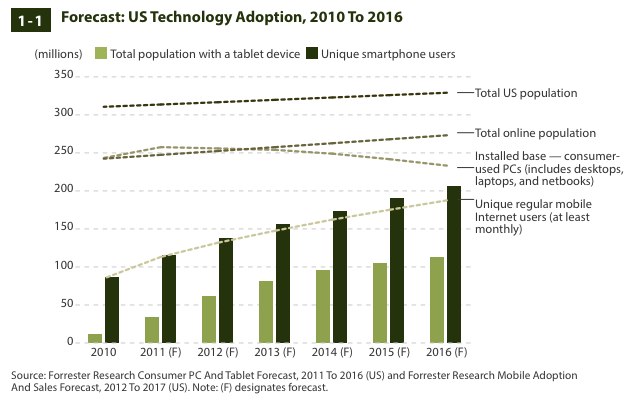
One trend that the Forrester report, which includes…
Continue reading here!
//Richard


 The IT Melting Pot!