Archive
#Citrix #Receiver 5.7.1 for iOS released
Ok, another version of Citrix Receiver released!
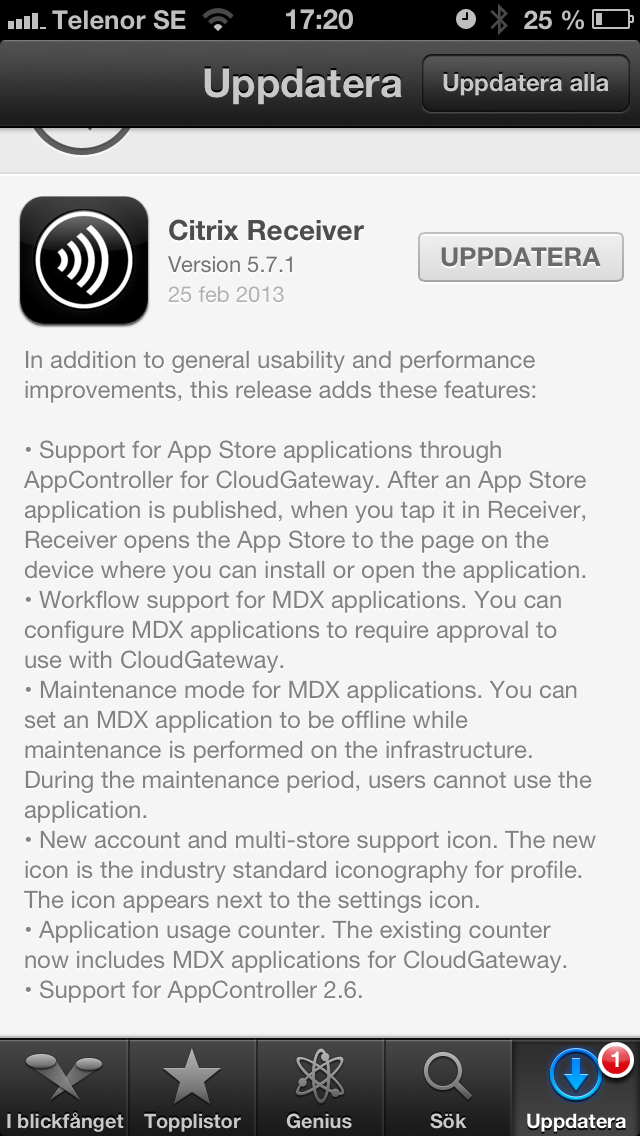
Read more about it here (no detailed 5.7.1 info yet but I guess it’s coming soon)!
//Richard
It’s here! #Citrix #Receiver for Win 8/RT 1.2
The first official release for your touch-enabled Win RT tablet or Windows 8 Pro device now on the Windows Store! It adds the ability to connect to XenApp Services and XenDesktop Services sites for Web Interface deployments, not just StoreFront enabled sites. Connections can be direct or through Access Gateway Enterprise Edition. We also added the ability to open ica files if you’re using browser access. And we shouldn’t overlook the ability to save your password, if allowed by server policy.
This version will be useable in more configurations.
Click here to try this version. It is still a good idea to ask your IT department if it can be used in your environment. IT managers can find details on configurations supported and settings at Citrix eDocs.
Here is what it provides:
- Secure access to virtual desktops and enterprise apps
- Secure access to Web and SaaS apps (requires CloudGateway Enterprise)
- Work anywhere on any Windows 8 computer or tablet
- Account configuration using your email address, a server URL, or a provisioning file
- Auto-provisioned applications
- Use one published app at a time, along with multiple Web and SaaS apps
- Automatic display of the keyboard when needed
- Use of native controls for selecting an item from a list
- Option to save your Receiver password if allowed by server
And more functionality is coming
Look for updates every few months. Among other improvements, we’ve started work on multi-touch, audio, session sharing (support for multiple sessions)…
Continue reading here!
//Richard
#Citrix #StoreFront Planning Guide
Ok, this product has caused some headache since it was released. And I must say that this guide is something that Citrix should have release a long time ago… there are so many companies out there struggling with how to deal with Web Interface being faced out and how/what to do with StoreFront!
So enjoy!
Download StoreFront Planning Guide!
//Richard
Mac Receiver Launches Application and Closes Abruptly – #Citrix, #Receiver
Ok, had a bit of a “challenge” today with my little Receiver 11.7 on my Macbook Air…. the darn thing just “vanished” after the XenApp/XenDesktop session was shown for about half a second…
And the solution was the following:
Symptoms
User is unable to login from a MacBook using the Citrix Receiver for Mac. The session launches and eventually disappears without any error message.
Cause
Since the Mac devices do not have a registry like Windows devices, a license needs to be issued to the client devices name. If the device does not have a name then it cannot be issued a license. It attempts to assign a license to a null value, which it cannot do and hence the session drops.
Resolution
- Find the System Preferences Icon on the toolbar.

- Open the Sharing folder in the System Preferences options.

Host checks/EPA scans are not for everyone – #Citrix, #NetScaler, #AccessGateway
This is an interesting blog post from Citrix… It captures a scenario that I know one of my previous customers was thinking of, so have a look at it!
The main thing that think of when reading this though is that EPA scans are NOT for everyone, I agree. And please also read my earlier posts on why it cannot be done with todays products from Citrix.
#Citrix #SmartAccess = A complete story or not? – #NetScaler #AGEE #EPA
Even though the latest Receiver Receivers changed some scenarios and enables host checks/EPA scans it still doesn’t provide the full picture. But I’ll be publishing a more detailed picture on why later, some late night I’ll be able to complete it! 😉
Here you have the blog post from Tobias Frigger:
A customer of one of my Citrix Consulting colleagues recently came up with an interesting request.
Like many others they are using Citrix NetScaler’s Access Gateway Enterprise Edition module to grant remote secure remote access to applications and desktops.
Additionally, they use a client management and software distribution solution to deploy the EPA plugin to client computers and therefore wanted to suppress Access Gateway offering the EPA scan plugin for download through the browser. This introduces some additional level of control over which client is entitled to connect through Access Gateway.
An approach restricting certain user groups from logging in by using group memberships is a more common scenario, but in this case the customer intended to restrict the end points and not the users. When end users lack administrative permissions to install custom software, preventing the download is indeed an effective measure.
A job for Citrix Consulting!
As you know, Access Gateway Enterprise Edition offers two ways of running Endpoint Analysis (EPA) scans – before and after authentication. Consequently, there are two procedures.
The formal requirements
- Remove the download button displayed when accessing the AGEE virtual server and the plugin is not detected by the browser or if the plugin is outdated
- Alter the message text such that it refers user to contact their system administrator if they think the plugin should be installed.
- When using a post-authentication EPA scan, add a “logout” button.

Backup
As a precaution, we want to make backup copies…
Continue reading here!
//Richard
#Citrix Receiver for HTML5 Version 1.1 Released – #Receiver
Citrix Receiver for HTML5 Version 1.1 is released.. And it now has the support for all the Major Desktop Browsers.
Version 1.1 supports the latest updates of the following Desktop browsers
- Internet Explorer 10
- Safari 6
- Google Chrome
- Firefox
You can download this from https://www.citrix.com/content/citrix/en_us/downloads/citrix-receiver/receivers-by-platform/receiver-for-html5/
eDocs Location : http://support.citrix.com/proddocs/topic/receiver-html5-11/receiver-html5-version-wrapper.html
Key things to check out for while installing and configuring Citrix Receiver for HTML5 v1.1
Direct Internal Acces
- XenApp 6.5 server to be updated with FP1 and latest Hotfix
- Install the NEW Citrix Receiver for HTML5 Version 1.1 on your Storefront 1.2 server (Uninstall the old version manually before installing this new version)
- Open the installed “Citrix HTML5 HDX Engine Configuration” tool and Add the “Receiver for Web” URLs to configure for HTML5 access
- You can now open the supported browsers listed above on the client side and enter the “Receiver for Web” URL
- If you are prompted with the logon screen where you have the option to download the native Citrix Receiver, just click on “Log on”
- Now, add your application/desktop and click on it to launch
- You have your application running in a browser Tab!!
- For this, you will just need to have the latest Access Gateway 10 version 10.0.71.6014.e
Forum : You can use Receiver for HTML5 Forum for reporting issues, questions, and general discussions.
KB articles : You can refer to the below KB articles to troubleshoot some of the cases.
Known Issue : With Internet…
Continue reading here!
//Richard
#Citrix Knowledge Center Top 10 – December 2012
Citrix Support is focused on ensuring Customer and Partner satisfaction with our products.
One of our initiatives is to increase the ability of our Partners and Customers to leverage self-service avenues via our Knowledge Center.
Find below the Citrix Knowledge Center Top 10 for December 2012.
Top 10 Technical Articles
| Article Number | Article Title |
|---|---|
| CTX129229 | Recommended Hotfixes for XenApp 6.0 and Later on Windows Server 2008 R2 |
| CTX129082 | Application Launch Fails with Web Interface using Internet Explorer 9 |
| CTX132875 | Citrix Receiver Error 2320 |
| CTX804493 | Users Prompted to Download ICA File, Launch.ica, Instead of Launching the Connection |
| CTX105793 | Error: Cannot connect to the Citrix server. Protocol Driver Error |
| CTX133997 | Citrix Receiver 3.x – Issues Fixed in This Release |
| CTX127030 | Citrix Guidelines for Antivirus Software Configuration |
| CTX101644 | Seamless Configuration Settings |
| CTX676151 | How to Install the Citrix ICA Web Clien |
| CTX325140 | Manually and Safely Removing Files that might remain on a System |
Top 10 Whitepapers
| Article Number | Article Title |
|---|---|
| CTX131577 | XenApp 6.x (Windows 2008 R2) – Optimization Guide |
| CTX132799 | XenDesktop and XenApp Best Practices |
| CTX101997 | Citrix Secure Gateway Secure Ticket Authority Frequently Asked Questions |
| CTX133185 | Citrix CloudGateway Express 2.0 – Implementation Guide |
| CTX129761 | XenApp Planning Guide – Virtualization Best Practices |
| CTX134943 | XenDesktop and XenApp Printing – Planning Guide |
| CTX122978 | XenServer: Understanding Snapshots |
| CTX134081 | Planning Guide – Citrix XenApp and XenDesktop Policies |
| CTX128277 | Logon Optimization Guide – XenApp/XenDesktop |
| CTX110351 | User Profile Best Practices for MetaFrame Presentation Server |
Top 10 Hotfixes
| Article Number | Article Title |
|---|---|
| CTX132122 | Hotfix Rollup Pack 1 for Citrix XenApp 6.5 for Microsoft Windows Server 2008 R2 |
| CTX126653 | Citrix Online Plug-in 12.1.44 for Windows with Internet Explorer 9 Support |
| CTX133066 | 12.3 Online Plug-In – Issues Fixed in This Release |
| CTX133882 | Hotfix Rollup Pack 2 for Citrix XenApp 6 for Microsoft Windows Server 2008 R2 |
| CTX135025 | Hotfix XA650R01W2K8R2X64033- For Citrix XenApp 6.5 for Windows Server 2008 R2 |
| CTX116550 | Credential Handling Weakness in Presentation Server Client for Windows |
| CTX135709 | Hotfix XS61E006 – For XenServer 6.1.0 |
Continue reading here!
//Richard
Lifecycle Milestones for Citrix Receiver – #Citrix, #Receiver
For each major version (e.g., v3.0) of a Citrix Receiver for Windows, Mac, Linux, Java, or WinCE, customers will receive a minimum lifecycle of four years. The lifecycle consists of a Mainstream Maintenance Phase for at least the first three years followed by an Extended Maintenance Phase for the remainder of the lifecycle. The specific dates for each major release of these components will be posted in the tables below.
During the Mainstream Maintenance phase, customers that remain current in a Citrix Technical Support program receive 24x7x365 worldwide support. Support includes assistance from experts and connects you to the latest troubleshooting tools, techniques and resources you need to protect your Citrix investment. Citrix will provide code-level maintenance in the form of minor version releases, and in some cases, Cumulative Updates (maintenance releases containing multiple fixes) when Citrix determines they are required to resolve issues with Receiver. The release of a minor version or Cumulative Update may define a new maintenance baseline. Citrix customers may be required to upgrade to a specific minor version or Cumulative Update to receive continued maintenance. When a new maintenance baseline is defined, Citrix will continue to provide support for each minor version (e.g., v3.3) for a minimum of 12 months after the release of the next minor version (e.g., v3.4). Minor versions may include functional enhancements as well as code-level maintenance.
During the Extended Maintenance Phase, technical support continues as before but code-level maintenance will be limited to security-related issues deemed critical by Citrix.
For Citrix Receiver for Android, Chromebook, iOS, or Windows 8/RT, customers that remain current in a Citrix Technical Support program receive 24x7x365 worldwide support for the version of Receivers that are currently available from the respective vendor app store. Code-level maintenance is provided with the next version made available in the respective vendor app store.
Lifecycle dates for Citrix Receiver for Windows, Mac, Linux, Java, and WinCE
The tables below list the major versions…
Put Citrix Receiver App Banners in Web Interface for Android and iOS – #Citrix, #Receiver
A good blog post from Roy Tokeshi about Citrix Receiver setup and provisioning.
I’ve used the Citrix Mobile Receiver Setup URL Generator for quite some time and like it (but now of course you’ll get pretty far with email-based enrolment if you can use that), but it’s still valid for some use cases and scenarios. But to add the banner to the download of the app itself is something I’ve not done, interesting!
One of the cool things you can do to help your users connect to your XenDesktop and XenApp environments is the Citrix Mobile Receiver Setup URL Generator at:http://community.citrix.com/MobileReceiverSetupUrlGenerator/

The output of this generator is a couple of links. The first is an iOS configuration link and the second is the Android configuration link. What is great about this is once the user gets this link on their iOS or Android device, via email, text message, or carrier pigeon with a micro SD card strapped to its leg , all the user has to do is click on the link and the local instance of the mobile Citrix Receiver is auto-configured.
- VCDC Email
- Application warning iOS
Something that Apple had made available is called a Smart App Banner. (I suggest that you don’t shout “Smart App Banners!” across the cube farm unless you want to start a bunch of prairie dogging or HR emails.) Regardless, the folks at Apple created an easy way for you to advertise the Citrix Receiver app itself from within web interface. At Citrix Systems we have had had a couple of different temporarily consistent hostnames we point at to get our apps and desktops. Among my customers, apps.company.com or atwork.company.com have popped up a few times. The point being, the user puts a name in the browser and the web interface client detect takes over, suggests a client version for Mac, Windows, Java and off they go to application or desktop nirvana. But what about the lonely neglected mobile devices. We tell our bosses that we need iPhones, iPads, and Androids for work. So the smart thing to do is to get a few work apps on there before bosses catch us playing Angry Birds, or Radical.FM So the question is, “How do I use this on my web interface?” That is an excellent question. We are going to take the cute little meta tag referenced in that Apple Dev article and paste that right into the login.aspx file in our web interface site. For the purposes of demonstration, I’m going to use our Virtual Computing Demo Center or VCDC as an example. The default web interface that acts as a front end of the demo instance is hosted on a virtual machine acting as the DDC for XenDesktop. The screenshots I am using are based on the connection I make to a XenApp desktop logged on as administrator. \\ddc\c$\inetpub\wwwroot\Citrix\DesktopWeb\auth\login.aspx looked like this:

Now, modified at the top line it looks like this.

Remember that this is something that is only supported in iOS and in fact from the default Safari browser. Here are some screenshots…
Continue reading here!
//Richard
Great UI Theme improvement setting – #AccessGateway, #NetScaler, #Citrix
I must say finally! It’s not a 100% yet for everyone out there but it’s a step in the right direction. The NetScaler, Access Gateway, Web Interface, StoreFront and Receiver has not really been in synch when it comes to UI and end-user experience…. But now Citrix has improved it!
Access Gateway is a secure remote access product and hence tends to be the entry point for corporate users, wanting to access their enterprise applications and desktops. Given this, it makes sense for corporates, to try and customize the logon experience on Access Gateway, to match their corporate look and feel.
Access Gateway has always allowed for this customization, though, it’s been somewhat of a tedious process. With the new 10.0.71.6014.e release, we are making an attempt to simplify this experience.
UI Customization on Access Gateway is a multi-step process:
- Access the built in theme web pages and customize them, to match the corporate requirements
- Apply the modified theme (collection of web pages) at the right location
- Modify certain scripts to make this change persistent
- Every time the firmware has to be upgraded, take a backup of the customized pages and scripts and re-apply the same after the upgrade.
A quick Google search will give you a number of helpful and very accurate blogs/articles, on how to tweak the web pages to customize and create your corporate look and feel. Some of my favorites are:
- http://blogs.citrix.com/2012/04/19/green-bubble-theme-for-citrix-netscaler/
- http://jariangibson.com/2012/04/16/apply-citrix-receiver-theme-to-netscaleraccess-gateway-10/
With this new release, we have automated all the other steps (i.e. 2-4) for you. Instead of having to worry about how to apply this theme, or having to take backups every time you upgrade, the new release will automatically handle this for you.
To see the new offering in this r…

Continue reading here!
//Richard




 The IT Melting Pot!