Archive
#Citrix #XenMobile 8.5 MAM upgrade! Part 1 – #StoreFront, #AppController, #NetScaler
In this little blog series series you’ll follow a little upgrade process to XenMobile 8.5 for Mobile Application Management (previously known as CloudGateway).
Ok, I don’t exactly know where to begin. I must first say that Citrix is THE master when it comes to renaming products, updating/changing the architecture, changing consoles (claiming to reducing the number of them like every year but at the same time introduce new ones).
How hard can it be to make crystal clear documentation and upgrade processes that works and are easy? I feel already that my tone in this blog post is “a bit” negative… but I think that Citrix actually deserves it this time.
I must now take a step back and calm down and point out that Citrix is delivering some MAJOR changes and good news/features in the new XenMobile 8.5 release though! It’s great (when you’ve got it up and running) and I must say that I don’t see anyone that is near them in delivering all these capabilities in a nice end-to-end delivery!! 🙂
Have a look at everything that is new, deployment scenarios etc. here before you even start thinking to upgrade or change your current NetScaler, StoreFront and AppController environment!
Once you’ve started to read the different design scenarios you’ll see that App Controller can be placed in front of StoreFront, in the back of StoreFront or totally without StoreFront… all the options just make your head spin! Because Citrix doesn’t really make it clear on how all of this should work with a Receiver and Worx Home depending if the device is on the internal network, external through NetScaler or what the capabilities that you need are supported in the different scenarios in a simple way, just text that explains it. And I find the pictures and text a bit misleading:

As you see above the App Controller is added as a “Farm” just as in 2.6, but is that the truth now in version 2.8 of App Controller?
If you have a look at the text from this page it’s getting even more confusing: Read more…
10 Mobile Device Management Leaders That Help IT Control #BYOD, #Gartner, #Citrix, #MDM
Consumers love their smartphones and tablets, so it should come as no surprise that they want to use their devices at work. The pressure to develop and deploy a bring-your-own-device (BYOD) policy is on and coming from every direction, including the ‘C’ suite of executives who tend to be especially keen on using smartphones and tablets for their work.
Managing devices in a BYOD environment is no small feat, and the right mobile device management (MDM) product is a key component in making it work. Here are 10 leading MDM vendors in the market today, drawn from the leaders and visionaries in Gartner’s 2013 Magic Quadrant for Mobile Device Management Software.
Magic Quadrant

Citrix Worx Apps announced! #CitrixSynergy, #BYOD
“Worx Enroll” and “Worx Home” apps announced to support the MDM, MAM, Web, Saas and Win apps/desktop (XA/XD) from ONE STORE!!
This is something that we all have been waiting for!! Finally a one-stop-shop/app in where an end user can use their personal devices and consume MAM, MIM and WaaS (Windows as a Service) deliverables without enrolling to a full MDM service. And those devices that are corporate assets enables you to do the same delivery and add the MDM capabilities needed (e.g: geofencing, pass code and other policies and asset mgmt) with the same end user UI!!!
I want to see this in action and get my hands on it NOW! 😉
//Richard
Enable Enterprise #Mobility and Secure Android, iOS and Windows Devices – #BYOD
This is a good blog post from Christopher Campbell that also has links to Citrix BYOD Solutions and Citrix BYOD Starter Kit.
Lots of devices with many different operating systems. Lots of users bringing Android, iOS and Windows mobile devices into the workplace. Securing all these devices and the apps and data they’re accessing can make enabling Enterprise Mobility an intimidating task. Is it going to be BYOD, COPE, MDM, MAM, MIM or a combination? One size doesn’t fit all and addressing these challenges can be painful if you’re deploying a multiple vendor solution stack.

Some of the top mobile threats now include but are not limited to:
- Data loss from lost and stolen devices
- Information stealing mobile malware
- Vulnerabilities from device, OS and 3rd party apps
- Insecure Wi-Fi, network access and rogue access points
- Insufficient management tools and capabilities
Join Citrix Chief Security Strategist Kurt Roemer to find out how IT can maintain control and protect business information accessed from Android, iOS and Windows tablets and smartphones.
Watch Now and you will learn:
- Security considerations and risk mitigation options when supporting BYOD
- The architecture required to support tablets and smartphones accessing sensitive business information
- How Citrix BYOD solutions enable secure access to enterprise desktops, apps and files from any device
- Best practices for IT to maintain control over Android, Apple iOS and Windows tablets and smartphones used in the workplace
WATCH ON-DEMAND TODAY and learn how to make a complete end-to-end, fully integrated Enterprise Mobility solution work for the business, user and IT…
Continue reading here!
//Richard
#Citrix #XenMobile #MDM Integration With #Cisco ISE for #BYOD
Interesting and a good blog post by Sameer Mehta.
World of BYOD
Bring your own device (BYOD) initiatives are enabling employees to bring their own personal devices to work and allowing them corporate access to services such as Email. We did a recent audit using our ability to integrate with security incident and event management (SIEM) systems for a customer. The audit provided visibility into their ActiveSync traffic and found devices that belonged to executives that were not under IT management. Here’s a snapshot of their BYO devices.

There are several reasons to enable such access – for example, to boost employee productivity or convenience of accessing email from any device. Having said that, as Uncle Ben puts it, “with great power comes great responsibility”, and this responsibility is on the IT administrator from a security point of view. It’s IT’s responsibility to make sure that corporate data is not compromised or leaked in the following scenarios:
- What happens when this personal device is lost or stolen?
- What happens if this device is jailbroken or rooted?
- What happens if this device ends up outside an approved geofence. For example, outside of the US?
- What happens if the user inadvertently installs an application that has the ability and access to the entire device memory, thereby having unauthorized access to corporate data?
End User’s perspective on Enterprise Mobility
End users want access to corporate services such as email, intranet, ability to share and collaborate over documents, and also use 3rd party applications such as Evernote, Quick Office or GoodReader. With mobile solutions such as XenMobile MDM, CloudGateway, ShareFile and GoToAssist, Citrix provides ubiquity i.e. ‘access any app. from any device’, and a unified view for applications with an enterprise app store, documents via ShareFile. Having said that, since the user is accessing multiple applications; end user experience is a key component of mobility solutions. For example, bootstrap authentication and provide single sign on (SSO) to other applications.
Enterprise IT perspective on BYOD
As IT is providing access to corporate services, the main concern is around data loss prevention (DLP) and protecting corporate content on the mobile device. This means, encrypting data at rest for application data, and documents that are hosted either on Sharepoint, Network File share or Cloud storage. From a DLP perspective, for security conscious organizations, the mobile solutions bundle, which includes XenMobile MDM and CloudGateway…
Continue reading here!
//Richard
Are you, or wanna become a Mobility or Networking guru? – #EnvokeIT, #Citrix, #XenMobile, #BYOD
Then you might be the one that we’re looking for!!
EnvokeIT is expanding and are looking for people with the following areas of expertise:
Mobility
Are you currently working within the mobility area or with any of the major Mobile Device Management products out there (MDM, MAM, MIM etc.)? Then we’d love to talk to you! We strongly believe in this area and are focusing on it and would like to have you onboard on this journey! And of course we’re focusing on the Citrix product portfolio but are mainly looking for people with experience within the area and not exclusively on the Citrix XenMobile/Zenprise products. And Enterprise Mobility Management is here to stay, it’s the future work-/play-ground!
Networking
Wow, this is an area that is exploding! And I must agree that I’m not the expert within this area, but there are so many new capabilities being developed right now and we and our customers see the business value here. We’re talking about everything from traditional old school SSL VPN to supporting the latest mobility, application and cloud delivery solutions out there! So if you have experience on the Citrix NetScaler product or are a current Cisco, F5 or Riverbed person; contact us to hear more on what we have to offer!
Contact us – EnvokeIT (form page),or if you rather contact me or Mathias directly:
Richard Egenas – CTO
Email: richard-at-envokeit-.-com
Phone: +46 (0) 768 81 01 62
Mathias Törnblom – CEO
Email: mathias-at-envokeit-.-com
Phone: +46 (0) 8 587 633 10
Thanks for taking your time reading this and I hope that you will join us on this journey!! 🙂
//Richard
XenMobile product overview… and It’s nice! via @BasvanKaam – #BYOD, #MDM, #Citrix
Wow! I must say that Bas van Kaam has done a great wrap-up here! I highly recommend you to read this blog post!!! 🙂
It was only about a month ago when I was writing my Blog about the CloudGateway that I wondered which route Citrix would take now that they acquired Zenprise, well… here it is… XenMobile, another Xen sibling sees the light! Lets jump right in…
I had the opportunity to make use of one of Citrix’s demo environments to have a closer look at MDM, which is an awesome way to explore new and existing products by the way, if your company is a Citrix partner and has access I definitely recommend having a look. Besides that I used the Citrix E-Docs website as well as Citrix.com to find as much information as possible.
The main focus of this article will be on XenMobile MDM as the Mobile Solutions Bundle (one of the two editions available) focuses primarily on the CloudGateway which I already discussed in one of my previous blogs.
MDM?
MDM stand for Mobile Device Management and it’s just that! Here’s what Citrix has to say about it: As per Citrix: XenMobile MDM is a robust mobile device management solution that delivers role-based management, configuration, and security for both corporate and employee-owned devices. Upon user device enrollment, IT can provision policies and apps to devices automatically, blacklist or whitelist apps, detect and protect against jailbroken or rooted devices, and selectively wipe a device that is lost, stolen, or out of compliance. Users can use any device they choose, while IT can ensure compliance of corporate assets and secure corporate content on the device.
Editions
There are two editions: XenMobile MDM and the Mobile Solutions Bundle. XenMobile MDM primarily focuses on (hardware) device management, more on it’s extensive feature set shortly. Every major platform is supported including: iPhone, iPad, Android, BlackBerry, Symbian and Microsoft Windows 8. It includes the XenMobile Secure Mobile Gateway (SMG) and XenMobile SharePoint Data Leak Prevention (DLP) as well as the XenMobile Mobile Service Provider (ZSM) and the XenMobile Remote Support Application Toolset.
#Citrix Nails Its Enterprise Mobility Strategy – #XenMobile, #BYOD – via @ekhnaser
Read this great article and see if you agree! 😉
Citrix Nails Its Enterprise Mobility Strategy
I have been very pleased with the strategy, execution and the road map that Citrix has developed around Enterprise Mobility. With the announcement of XenMobile MDM and the Mobile Solutions bundle, I can very easily say that the Citrix solution is the most complete and feature-rich offering on the market today.
XenMobile MDM is simply a name change for Zenprise, which Citrix acquired a few months earlier. I expected Citrix to simply change the “Z” to “X” and keep the name, but I guess Citrix marketing did not find that as amusing. That is not the only change that occurred: A new version of “Zenprise” also accompanies this release, and XenMobile MDM now brings it to version 8.0.1.
Many customers and colleagues have asked me why Citrix acquired an MDM provider — what are the value-adds and isn’t the world moving towards MAM anyway? To answer, we have to make a clear distinction between the use cases. I agree and concur that for BYOD initiatives, MAM is a better, cleaner way of doing this things and that MDM is not the ideal solution.
That being said, there are plenty of use cases where MDM is the only solution that makes sense and I will give you real-world examples. Have you heard of the “Belly” card? It is a customer recognition and rewards program from a company HQ’ed in Chicago that offers merchants a locked down iPad for display in their place of business. Customers can come in and scan their mobile phones on the iPad provided and after a certain number of check-ins they are offered a reward for their loyalty. In this case, belly would have very little use for MAM; they need an MDM solution to manage the thousands of iPads they have deployed.
Another example: United Airlines and American Airlines allow customers to use mobile devices in the cabin to purchase goods in-flight. Obviously, the airlines don’t want the flight attendants to use their own device for this, MDM shines again here.
Finally, what about financial institutions that want to continue to issue corporate-managed devices of different flavors? It’d be for security reasons, obviously. In this case, MDM shines.
When I see bloggers and analysts disqualify MDM, they are not thinking beyond BYOD, where the business world could have a use case built around an application they issue on a mobile device.
Did Citrix strike gold with its acquisition of Zenprise? I will say this much: It was one of the best acquisitions the company has ever made. The natural follow-up question is, what about CloudGateway? And my answer is, it is the glue that holds everything together and is the most important product in the Citrix solution today. Everything will go through CloudGateway moving forward and at version 2.5 has the following features:
- Enterprise app store with identity management capabilities for a single sign-on like experience
- Windows Applications and Desktops through XenApp and XenDesktop
- Mobile applications integration, provisioning, etc.
- SaaS applications integration, provisioning, etc
- Integration with Citrix ShareFile for enterprise DropBox functionality
CloudGateway also has a connector for Citrix Podio, and here I’ll be critical of Citrix the same way I’m critical of VMware for not integrating SocialCast. Why Citrix doesn’t make Podio…
Continue reading here!
//Richard
Working with #XenMobile #AppController and Me@Work apps – #Citrix, #BYOD
I got to play around with @WorkWeb and @WorkMail apps a bit… and I must say that the process to get the Me@Work apps into AppController isn’t the simplest there is for someone that haven’t been doing iOS app development before.
But what I’m describing here is what’s now named XenMobile AppController and a part of the XenMobile bundle:
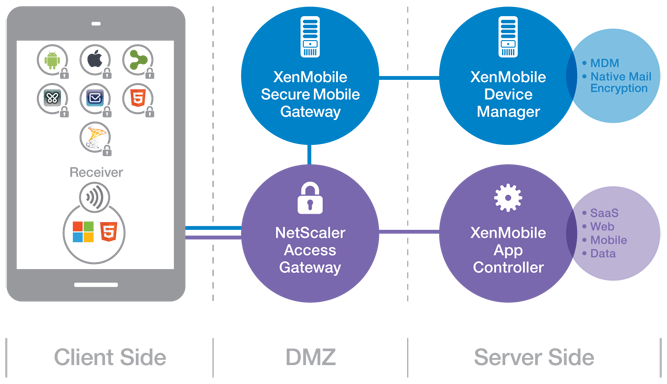
(Note: picture from Citrix)
So lets try to summarise the steps involved in getting these @WorkWeb and@WorkMail apps into your AppController and then published them to your users!
- Get your hands on a Macbook!
- Download the App Preparation Tool for iOS Applications and install it on the client
- Download and install Xcode (not 100% necessary but I recommend that you do that to simplify the creation/download of Distribution certificates and Distribution Profiles)
- Open XCode and open Preferences->Downloads,
 Read more…

#Citrix #BYOD Architecture overview – #XenMobile, #Mobility
I must say that this blog post is of course Citrix “twisted”, but I really like it! And it shows how Citrix provides a pretty complete offering in order to deliver Mobility- and BYO-compliant services.
The Citrix blog written by Christopher Campbell makes sense and I also agree that a picture is worth a thousand words! 🙂
I’m going to make this real easy and simple. As my grandfather would say “A picture is worth a thousand words”.
If you’re a XenDesktop or XenApp customer this is what your environment probably looks like.

Now this is what you need to enable BYOD and add that MAM, MDM, MIM (Data) and overall EMM functionality you’re looking for.

This is what your environment looks like after you enable BYOD.

Didn’t get that? OK, here is what BYOD looks like with multiple vendors.

Now, here is what BYOD looks like with Citrix.

Got it?
Read the whole blog post here!
//Richard


 The IT Melting Pot!