Archive
Remote Desktop Services are now allowed on #Windows #Azure – #RDS, #TS, #XenDesktop
This is a great thing that you should have a look at and investigate how it would fit you and your organization! Finally Microsoft has changed the license model! They still have some work to be done on it though so we can run Virtual Desktops (VDI’s) as well!! 😉
Read this great blog post from lpanzano:
I’ve not seen a lot of news about this so I thought it was worth writing a short post just to remember everyone that on July 1st, Microsoft has officially changed Windows Azure licensing terms (PUR) to allow the use of Remote Desktop Services (RDS) on Windows Azure Virtual Machines. Previously this scenario was not allowed in Windows Azure. Before July 1st you could only access an Azure Windows Server VM for purpose of server administration or maintenance (up to 2 simultaneous sessions are authorized for this service).
Let’s see some details about this change:
-
To enable more than 2 simultaneous sessions you will need to purchase RDS Subscriber Access Licenses (SALs) through the Microsoft Services Provider Licensing Agreement (SPLA) for each user or device that will access your solution on Windows Azure. SPLA is separate from an Azure agreement and is contracted through an authorized SPLA reseller. Click here for more information about SPLA benefits and requirements.
-
RDS Client Access Licenses (CALs) purchased from Microsoft VL programs such as EA, do not get license mobility to shared cloud platforms, hence they cannot be used on Azure.
-
Windows ‘Client’ OS (e.g. Windows 8) virtual desktops, or VDI deployments, will continue to not be allowed on Azure, because Windows client OS product use rights prohibit such use on multi-tenant/shared cloud environments.
-
Customers can use 3rd party application hosting products that require RDS sessions functionality (e.g. Citrix XenDesktop), subject to product use terms set by those 3rd party providers, and provided these products leverage only RDS session-hosting (Terminal Services) functionality. Note that RDS SALs are still required when using these 3rd party products.
Continue reading this post here!
Citrix also created a good blog post on their view of the top 5 scenarios for putting XenDesktop on Azure:
Top 5 Scenarios for XenDesktop on Windows Azure
Since Windows Azure launched I have looked forward to the day Citrix would be able to work jointly with Microsoft to support XenDesktop and XenApp workloads. We are excited that today is the day we announce support for XenDesktop 7 and XenApp 6.5 on Windows Azure. Customers can now take advantage of the leading Citrix desktop virtualization solution and all of the HDX user experience goodness on Microsoft’s leading public cloud. With the announcement we’ve published two design guides (here andhere) to help get you started with your deployments.
10 Mobile Device Management Leaders That Help IT Control #BYOD, #Gartner, #Citrix, #MDM
Consumers love their smartphones and tablets, so it should come as no surprise that they want to use their devices at work. The pressure to develop and deploy a bring-your-own-device (BYOD) policy is on and coming from every direction, including the ‘C’ suite of executives who tend to be especially keen on using smartphones and tablets for their work.
Managing devices in a BYOD environment is no small feat, and the right mobile device management (MDM) product is a key component in making it work. Here are 10 leading MDM vendors in the market today, drawn from the leaders and visionaries in Gartner’s 2013 Magic Quadrant for Mobile Device Management Software.
Magic Quadrant

#Citrix #NetScaler #SDX Installation Overview Video
This is a pretty good “quick” video of the SDX installation! Have a look at it, and remember not to use 1Gbps interfaces only if you want to run more than 7 VPX’s on the SDX! Then go for 10Gbps interfaces or many channels/interfaces of 1Gbps to not hit the SR-IOV limit of 7/1Gbps interface! 😉
Description
12:45 screen capture with PPT overview on IP Addressing, and walking through install, IP Change for SDX’s SVM and XS IPs, licenses, and then the install of a NetScaler instance with NSIP and SNIP. This is intended to be a quick overview before you set out on a first SDX install, and is in compliment with the SDX Quick Install Guide.
See the video here!
//Richard
Upgrading to #Citrix #Receiver for #Windows – why and how?
This is something that all Citrix admins should read! How many questions don’t U get about which version of the client to use and why etc?
This document describes the various versions of Receivers for Windows, lists the reasons for upgrading, and recommends best practices for upgrading to the latest version of Receiver based on specific circumstances.
Note: The Online Plug-in 12.x will reach end of its maintenance in March 2013. Customers using Online Plug-in with XenApp 5, XenApp 6.x, XenDesktop 4.x, or XenDesktop 5.x must upgrade to the latest version of Receiver for Windows 3.X prior to that date where practical.
Citrix Receiver is the latest Citrix software you install on Windows end points to gain access to virtualized apps and desktops. It is also regularly installed on virtual desktops to enable access to virtualized apps.
The name of Citrix client software and the built-in functions are changed over the years. The clients in common use today are the Online Plug-in for Windows 12.X and the Receiver for Windows 3.X.

Where the Online Plug-in for Windows 12.X provided Web and PNAgent support, Receiver for Windows 3.X provides additional support. It can be configured for self-service access to applications, VPN-less remote access, single sign-on the Windows, Web, and SaaS applications, and has a built-in method to check for updates.
Both the Online Plug-in and Receiver have two versions.
- The Online Plug-in Web is used solely for Web access to applications and the Online Plug-in (Full) supports Web access as well as PNA Services. The Full version supported SSO, Smart Cards, and access to apps through the Start menu
The standard Receiver for Windows, CitrixReceiver.exe, can be considered is a complete replacement for the Online Plug-in Web and largely a replacement for the Online Plug-in (Full). It can be used for web access. It can be configured to access PNA Services. And it can also be used with the latest versions of StoreFront, CloudGateway (App Controller), and Access Gateway to provide a rich set of services. It contains the latest, multithread, multi-stream HDX engine.

NEW #Citrix Apps and Desktops certifications – #CCIA, #CCE, #CCA, #XenDesktop
Ok, Citrix has now released the new certifications! Have a look, plan, study and take them! 😉
Now in Beta and launching live in early Q4 – a new solutions-focused certification program designed to validate IT professional skills for strategic app and desktop solutions in support of Citrix XenDesktop 7.

- Citrix Certified Associate – Apps and Desktops (CCA-AD) validates the skills IT operators and administrators need to manage, maintain, monitor and troubleshoot XenDesktop 7 solutions.
- Prepare with the Managing Citrix XenDesktop 7 Solutions training course.
- Pass the Managing Citrix XenDesktop 7 Solutions exam.
- Citrix Certified Professional – Apps and Desktops (CCP-AD) validates the skills experienced IT solution builders, such as engineers and consultants, need to install, configure and roll out common XenDesktop 7 solutions.
- Obtain the CCA-AD certification.
- Prepare with the Deploying Citrix XenDesktop 7 Solutions training course.
- Pass the Deploying Citrix XenDesktop 7 Solutions exam.
- Citrix Certified Expert – Apps and Desktops (CCE-AD) validates the skills experienced IT solution designers, such as architects, engineers and consultants need to assess and design comprehensive XenDesktop 7 solutions.
- Obtain the CCP-AD certification.
- Prepare with the Designing Citrix XenDesktop 7 Solutions training course .
- Pass the Designing Citrix XenDesktop 7 Solutions exam.
Update Paths
We have a simple transition path for you.
CCIAs and CCEEs may update to the new equivalent level by passing only one exam. Eligibility to update will require an unexpired credential. The update path for existing CCIAs and CCEEs will be available until this first version of the CCE-AD or CCP-AD exams are retired. We will provide 3 months notice of any changes to the update requirements or update path availability.
Existing Citrix Certified Administrators (CCAs) and Citrix…
Continue reading here!
//Richard
Choose your #Citrix #NetScaler … wisely… – via @hlouwers
This is a question I get a lot and I must say that Henny Louwers did answer it well in this blog post!
I spend a lot of my time breaking down the different models of Citrix NetScaler appliances and different Software Editions within the Citrix NetScaler portfolio.
I decided to set up a blog about this since the path is usually pretty much (lengthy but) the same. This does not mean the answer is always easy because there are a lot of questions that need to be answered.
The first thing I would like to get off my chest is the following: Stop seeing/selling the Citrix NetScaler as a replacement for Secure Gateway. It is so much more than that. I often have discussions with various engineers and consultants telling me that Citrix NetScaler is so expensive for a Remote Access solution because Secure Gateway always used to be free. No offense but a Citrix NetScaler solution belongs to the networking department, not the Citrix XenApp sys admin department. Or maybe limited.
That leads me to the first difficult thing of a Citrix NetScaler project. The adoption of the Citrix NetScaler appliances to the networking guys of an organization. They need to embrace the solution to make this a success. For some reason they too see it as a ‘’Citrix’’ solution. For that reason one of the most important meetings to setup is usually with the networking guys to try to explain the L3-L7 functionality of the Citrix NetScaler solution. When they realize it competes with F5, Juniper, Cisco, etc then we are on the right track.
NetScaler Gateway or NetScaler Standard Edition
Usually the first question of a customer is regarding something simple like replacing the Remote Access solution. Since the NetScaler is going to be the main platform for publishing Citrix publications a NetScaler Gateway can be considered as a valid option. This is when I tell a customer it would be wise to spend a little extra on the NetScaler Standard Edition since this would leverage the solution be having full load balancing capabilities (among others). When you compare prices between the NetScaler Gateway and NetScaler Standard Edition you will see that the Standard Edition will be somewhat more expensive but I for one think that it is worth the difference given the feature set that come with the Standard Edition. Of course the NetScaler Gateway can always be upgraded to a NetScaler Standard Edition (or higher) if you will.
Another feature of Citrix NetScaler Standard Edition is the ability to run Citrix Web Interface on the appliance. Honestly, I do think is not really that important anymore….
Continue reading here!
//Richard
Monitoring #Netscaler with Operations Manager 2012 – #SCOM – via @msandbu
Another great blog post by msandbu!!
This guide has been written with Netscaler build 73 and Operations Manager 2012 SP1 (on WS2012) with the management pack from Citrix.
Operations Manager 2012 supports monitoring network devices either through SNMP (v1, 2 and 3) or through just basic ICMP.
Citrix has made a management pack solution, which you can use to enhance the monitoring capabilities in SCOM.
The pack also includes VMM PRO management pack (Which is not gone through in this guide, just the basic management pack)
The management pack can be downloaded from mycitrix (Requires login)
https://www.citrix.com/downloads/netscaler-adc/components/netscaler-management-pack-for-operations-manager-2012.html
(Just a side note: Comtrade is a Citrix Partner who is currently making a new management pack for Netscaler so stay tuned for the new release )
So when we have a functional Operations Manager server up and running we have to install the SNMP service on one of the servers.
This can be done via Server Manager.

After that is installed go into services.msc and choose “Accept SNMP packets from any host” or just enter the IP of the Netscaler server.
Make sure that firewall on the OpsMgr server allows for SNMP traffic in…
Continue reading here!
//Richard
#XenDesktop 7 and #AppController setup – #Citrix, #MAM – via @msandbu
Good job on this blog post by Marius Sandbu!
XenDesktop 7 setup and AppController setup
So the big day is here, XenDesktop 7 is released from Citrix and with it ends the old XenApp architecture.
Support for Server based session hosts is still there but the architecture is merged into XenDesktop.
Other features include:
App-V integration
License console integrated into Studio
Storefront administration also from the same console.
The list goes on and pictures say more than a thousand words.
(Can also say that Citrix also released a new version of the Receiver platform for both Mac and Windows today, which includes support for XenDesktop 7 and Storefront.
http://blogs.citrix.com/2013/06/25/receiver-for-windows-4-0-released-today/
http://blogs.citrix.com/2013/06/25/whats-new-with-receiver-for-mac-11-8/
XenDesktop 7 can be downloaded from Mycitrix.com à
http://www.citrix.com/downloads/xendesktop.html
Now the installation is pretty straight forward just choose Standard delivery controller install and it will include all of the needed components. After they are installed we need to create a deployment.
When you start Desktop Studio we choose create new deployment.

So we create a new site…
Continue reading here!
//Richard
Finally multi-site and enterprise readiness of #StoreFront subscription DB! – #Citrix
This has been one of the things that many larger companies where asking for in the earlier versions of StoreFront (and to get rid of the SQL database of course). Before you could not in a supported/good/easy way get the user subscription database that contained all the items (apps and desktops) that the end-user had subscribed to replicated between sites and StoreFront groups.
For instance if you had a datacenter in Stockholm and then one in Beijing, and had a storefront server group at each datacenter and then used GSLB to load balance the StoreFront or Access Gateway access into those then users could travel and then end up on the other StoreFront group of servers and then didn’t have his/her subscriptions… this was not that good but with StoreFront 2.0 there is now support for how to synchronize the subscription database between the stores on the different groups/sites.
This is still a messy configuration I must say, how hard is it to build it into the console Citrix?!?! Same things as many of the config changes that you still have to do in web.config files…. really not that admin-friendly…
But here you find you how to setup the replication “jobs”:
And of course Citrix also added some other features in this new release:
What’s new
Separate database no longer required. The requirement for a separate database has been removed. Users’ application subscription data are stored locally and automatically replicated between StoreFront servers. For more information, see Plan your StoreFront deployment.
High availability and multi-site configuration. To enable load balancing and failover between the deployments providing the desktops and applications, you can define groupings and hierarchies, including specific backup deployments. You can restrict user access to specific resources by mapping deployments to Active Directory user groups. For more information, see StoreFront high availability and multi-site configuration.
Smart card authentication. StoreFront supports smart card authentication through both Receiver for Windows and NetScaler Gateway. Smart card authentication from desktop appliances and repurposed PCs through Desktop Appliance sites and XenApp Services URLs is also supported. For more information, see Use smart cards with StoreFront.
Receiver for HTML5 integration. You can configure Receiver for Web sites to enable users who cannot install Citrix Receiver to access their desktops and applications directly within HTML5-compatible web browsers. For more information, see Receiver for Web sites.
Desktop Appliance sites. You can enable users to access their desktops from non-domain-joined desktop appliances. The web browser on the appliance is configured to access the Desktop Appliance site for a store in full-screen mode at startup. For more information, see Desktop Appliance sites.
Receiver for Web site shortcuts. You can embed on your websites links to desktops and applications available through Receiver for Web sites. For more information, seeReceiver for Web sites.
XenMobile App Controller workflow integration. Receiver for Web site users can subscribe to applications to which you are managing access with App Controller user account management. For more information about App Controller user account management, see Configuring Applications for User Account Management.
#Citrix #XenDesktop 7 released – #RTW, #BYOD, #HSD, #VDI
Ok, it’s here! The official release is now available for everyone!
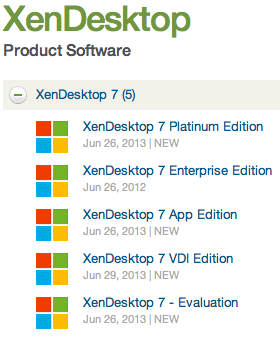
There are tons of blog posts and materials already out there and some great features as well that comes with this new release from Citrix. If you haven’t already played with the Excalibur release and know about them I suggest that you start evaluating and testing now!
Here are some good links to have a look at:
- XenDesktop 7 Overview
- XenDesktop 7 Feature matrix
- Excalibur is XenDesktop 7: what does this mean for XenApp and XenDesktop customers?
- XenDesktop 7: Upgrade & migration paths for XenDesktop and XenApp customers
- XenDesktop 7: AppDNA and Platinum Activation
- Reference Architecture: Director and EdgeSight
- XenDesktop 7 edocs – Documentation
- XenDesktop 7 Admin Guide
- XenDesktop 7 Upgrade Guide
- XenDesktop 7 Install Guide
Enjoy! 🙂
//Richard


 The IT Melting Pot!