Archive
More Than 50% of Mobile Apps Deployed Will be Hybrid – #Gartner, #BYOD
Gartner Says by 2016, More Than 50 Percent of Mobile Apps Deployed Will be Hybrid
Gartner’s 2013 Mobile and Wireless Predictions Reflect Mobility’s Impact on the Broader
With enterprises under extreme pressure from management and employees to develop and deploy mobile applications to accommodate mobile work styles and increase customer engagement, Gartner, Inc. predicts that more than 50 percent of mobile apps deployed by 2016 will be hybrid.
“Mobility has always been a separate topic for IT professionals, but it is now influencing mainstream strategies and tactics in the wider areas of technology enablement and enterprise architectures,” said Ken Dulaney, vice president and distinguished analyst at Gartner. “Increasingly, enterprises are finding that they need to support multiple platforms, especially as the [bring your own device] BYOD trend gains momentum.”
To address the need for mobile applications, enterprises are looking to leverage applications across multiple platforms. The advantages of the hybrid architecture, which combines the portability of HTML5 Web apps with a native container that facilitates access to native device features, will appeal to many enterprises.
The need for context awareness in mobile applications has increased with the capabilities of mobile devices, causing developers to consider both hybrid and native architectures. For applications to leverage location information, notification systems, mapping capabilities and even on-device hardware such as the camera, the applications need to be developed using either hybrid or native architectures. This has caused enterprise developers to consider alternatives to Web application……
Continue reading here!
//Richard
Faster, more secure access to business files on the go – #Citrix, #ShareFile,
Very interesting update to ShareFile apps or iOS! Especially the encryption on the devices by the pin-protection! This is something that I know companies have been waiting for! Thanks for a great blog post Peter Schulz!
Announcing all new updates to ShareFile for iPhone and iPad!
We hope you’ve had a chance to check out the ShareFile for iPhone and iPad apps – available for download from the Apple App Store. Today, we are excited to announce new features across both apps that address two major customer needs: 1) security and 2) access. These features include:
- Passcode support with local encryption – The ShareFile apps now allow the user to select a PIN to assign to an account in ShareFile. This provides a simpler means of accessing your account without having to type in your account password each time.
- Jailbreak Detection – This feature allows account administrators to block account access from devices that are detected to be jailbroken.
- Support for StorageZone Connectors – StorageZone Connectors let you connect existing file shares to ShareFile and access the data remotely on your iOS device. Customers have shared that they want easy access to their data wherever it’s stored across their organization. We built StorageZone Connectors with this in mind, allowing users to view data stored beyond ShareFile.

Each of these updates improves the mobile file sharing experience by making it easier and safer to access your data from anywhere. For everyday use, my personal favorite is passcode support with local encryption.

When I use my iPad, I don’t want to bother with setting up a device passcode for normal use, but I still want to protect my ShareFile data from anyone who might pick up the device. On the other hand, I don’t want to type in my (fairly long) password each time I launch the app. With this update, I can set a 4 digit PIN just for my ShareFile account. Where does the local encryption come in? ShareFile always flags your data for device encryption, but iOS will only enable that when you have a device passcode set. When you turn on the ShareFile PIN, we will encrypt your data using AES 256-bit encryption even though the iOS protection isn’t enabled…
Continue reading here!
//Richard
Win RT jailbroken to run 3rd party Desktop apps – #Windows, #RT, thx @brianmadden
It was only a matter of time: Windows RT has been hacked to allow non-Microsoft applications to run in Desktop. Prior to this hack, your Windows RT tablet (such as the Surface RT) could only run Metro apps, a special, touch-oriented version of Office… and that’s it. Now, in theory, you can run any Desktop app on Windows RT [See: What is Windows RT?]
The hack, performed by Clokr, exploits a vulnerability in the Windows kernel that has existed for a long time — since before Microsoft ported Windows from x86 to ARM, in fact. Basically, the Windows kernel on your computer is configured to only execute files that meet a certain level of authentication. There are four levels: Unsigned (0), Authenticode (4), Microsoft (8), and Windows (12). On your x86 Windows system, the default setting is Unsigned — you can run anything you like. With Windows RT, the default, hard-coded setting is Microsoft (8); i.e. only apps signed by Microsoft, or parts of Windows itself, can be executed.
Continue reading here!
//Richard
#AppController, #CloudGateway 2.5 released
Hi all,
I guess that some of you already are aware of the new 2.5 release of AppController (a part of the marketing product CloudGateway).. but it’s interesting with a release which I hope is making the product more enterprise ready and that the basic features now are there!
And I guess that many are interesting in that now Android apps, @WorkMail™ and @WorkWeb™ are supported!
I’ll of course do an upgrade and go through my little issue list I created earlier in the post-Synergy post… I hope that these items now are fixed!
- Enterprise/multi-site support with synch of the database. This to ensure that you can have an HA pair setup for instance in Europe and one in the North Americas and have the end-user be logged in against both and have their subscriptions etc. follow them (as well as of course reporting, monitoring etc. etc.)
- Support for really large AD domains with LARGE # of AD users and AD groups
- Support for AD domain structure where the BASE DN is different to where AD users and the AD security groups you want to use for roles
- Role based administration – this has just got to be there. Without it I wouldn’t call it an enterprise product…
These are the updates according to eDocs (they are quite a few so I have high hopes!) 😉
But when reading through the short list of updates I DON’T see multi-site support!! That’s not very Enterprise if you ask me…. This is the first thing I’m gonna check out!
Here is an architectural overview:
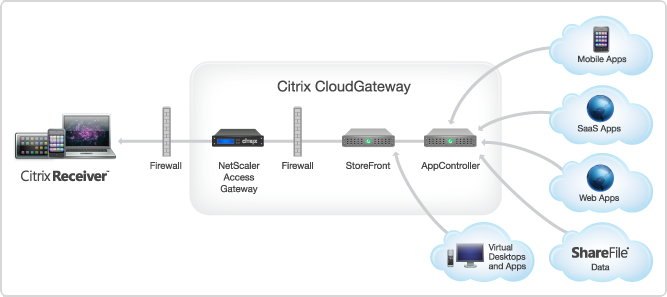
AppController 2.5 supports the following new features:
Free online Computer Science courses from #Harvard College
Ok, this is really interesting (at least for a nerd like myself)!
I just stumbled across this website where the Harvard College hosts some of its courses online, you can view video recording from classes, get access to all slides, source code etc and take the course for free yourself!
They now have the following courses up there;
- Computer Science 50: Introduction to Computer Science I – Introduction to the intellectual enterprises of computer science and the art of programming. This course teaches students how to think algorithmically and solve problems efficiently. Topics include abstraction, algorithms, encapsulation, data structures, databases, memory management, security, software development, virtualization, and websites. Languages include C, PHP, and JavaScript plus SQL, CSS, and HTML. Problem sets inspired by real-world domains of biology, cryptography, finance, forensics, and gaming. Designed for concentrators and non-concentrators alike, with or without prior programming experience.
- Computer Science 164: Mobile Software Engineering – Introduction to principles of software engineering for mobile devices and best practices, including code reviews, source control, and unit tests. Topics include Ajax, encapsulation, event handling, HTTP, memory management, MVC, object-oriented design, and user experience. Languages include HTML5, JavaScript, Objective-C, and PHP. Projects include mobile web apps and native iOS apps.
- Computer Science E1: Understanding Computers and the Internet – This course is all about understanding: understanding what’s going on inside your computer when you flip on the switch, why tech support has you constantly rebooting your computer, how everything you do on the Internet can be watched by others, and how your computer can become infected with a worm just by turning it on. In this course we demystify computers and the Internet, along with their jargon, so that students understand not only what they can do with each but also how it all works and why. Students leave this course armed with a new vocabulary and equipped for further exploration of computers and the Internet. Topics include hardware, software, the Internet, multimedia, security, website development, programming, and dotcoms. Through optional hands-on sections and workshops, local students have opportunities to dissect as well as upgrade a computer with additional hardware, search the Internet more effectively, build a wireless network, create digital images, eradicate spyware, and design webpages. Problem sets offer online students similar opportunities. This course is designed both for those with little, if any, computer experience and for those who use a computer every day.
- Computer Science E76: Building Mobile Applications – Today’s applications are increasingly mobile. Computers are no longer confined to desks and laps but instead live in our pockets and hands. This course teaches students how to build mobile apps for Android and iOS, two of today’s most popular platforms, and how to deploy them in Android Market and the App Store. Students learn how to write native apps for Android using Eclipse and the Android SDK, how to write native apps for iPhones, iPod touches, and iPads using Xcode and the iOS SDK, and how to write web apps for both platforms.
Continue reading and take the courses here!
Happy coding! 😉
//Richard
#Citrix #SmartAccess = A complete story or not? – #NetScaler #AGEE #EPA
This little blog post is about Citrix SmartAccess. I’ve been a fan of SmartAccess for a long time, and it’s also something that Citrix has been talking a lot about in their story. The way that Citrix technology can provide applications, desktops and information to end-users on any device in a secure and controlled way.
But the purpose of this blog post is to give you my view of this story, and how true the SmartAccess story is. Remember that this is my personal view and that I’ve actually not tested all my theories below so parts of it is purely theoretical at this stage.
So a bit of background first to build my case…
Citrix has been going on about SmartAccess, and it’s been true that the Access Gateway capabilities once added to Web Interface and XenApp/XenDesktop where great in terms of adding another layer of functionality that the IT supplier could use to determine how the XenApp and XenDesktop environments where accessed, and from what type of device. The device detection/classification is done through host checks (Endpoint Analysis Scans, EPA) that the Access Gateway feature provided as a pre- or post-authentication scan. This scan then resulted that either the device met the policies or didn’t, and then this policy could be leveraged by the other internal components (XenApp/XenDesktop) to control/manage which apps, desktops and functionality (virtual channels like printing, drive mapping etc.) that the end-user should get for that specific session.
And this was/is working well for certain scenarios from a technical point of view. But is it really working for the whole story that Citrix and the whole IT-industry is driving now with BYOD etc.? Think about the message that is being pushed out there today, use any device, we can control and deliver according to security policies, we can provide access from anywhere, etc…
And this is where it becomes interesting. All of a sudden then you as an architect are to take this vision that your CIO or IT-board has and realise it into manageable IT services that combined deliver a fully fledged IT delivery of Windows, Internal Web, SaaS, Mobile and Data for this great set of use cases and scenarios. Wow… you’ve got yourself a challenge mate!
This text is from the Citrix homepage about SmartAccess;
SmartAccess allows you to control access to published applications and desktops on a server through the use of Access Gateway session policies. This permits the use of preauthentication and post-authentication checks as a condition for access to published resources, along with other factors. These include anything you can control with a XenApp or XenDesktop policy, such as printer bandwidth limits, client drive mapping, client clipboard, client audio, and client printer mapping. Any XenApp or XenDesktop policy can be applied based on whether or not users pass an Access Gateway check.
So let’s start of then with going back to the SmartAccess which is the topic of this blog!
Fire Your CIO
Ok, yet another interesting article!
“The following post is by Mike Abramsky, principal of Red Team Global , which facilitates technology innovation via collaborative workshops and consulting.
Do you stifle productivity – or shoot the CIO?
That’s the dilemma increasingly faced by CEOs. With the rise of tablets, smartphones, social media, apps and personal clouds, we are in the midst of a profound computing shift, perhaps the greatest technology revolution in the enterprise since the invention of the PC. But the IT department with its risk-averse, slow-moving, heavy-handed culture threatens to torpedo hoped-for productivity.
This revolution is more than just technology; some CEOs recognize it as early days of Retooling the Enterprise. The ease of adoption of these new tools means non-technical staff can pursue faster, more flexible”
Continue reading here…
//Richard
HTML5 or Native for Mobile Apps? Try hybrid
Another interesting blog post from The HTML5 Center with some statistics from developers around their plans to adopt HTML5 for mobile apps.
HTML5 or Native for Mobile Apps? Try hybrid
What is your strategy? I guess that it’s HTML5 all the way so that you don’t have to make X number of builds for the various Android devices out there etc, but will the app perform as expected and will you be able to access all the features needed on the device, or will you revert to an hybrid or native approach like Facebook did?
//Richard




 The IT Melting Pot!
