Archive
My Post-Synergy View – Update 2 #CitrixSynergy #Citrix #CitrixSummit #XenApp #XenDesktop #NetScaler #Sanbolic
Hi again!
Ok, time to wrap up my Synergy update post series… In the previous post I started to give U my view of the takeaways from Citrix Synergy. So let’s continue! 🙂
As I wrote before I tried to structure the post using the following; each heading represents the enhancement request topic and/or the takeaway item, and then the subheading of Description and Status is showing you my personal view on the topic and its status.
NetScaler
Description:
These where the items that we had on the enhancement list before going to Synergy:
- Create SDX platform/architecture to run on all MPX appliances, for more info why see; NetScaler MPX vs. SDX dilemma; https://richardegenas.com/2012/10/03/netscaler-mpx-vs-sdx-dilemma/
- Add support for AG session policies so that ICA proxy can be turned on for specific published apps and desktops and not per session. This for situations where you might have one app or desktop that sits behind an AGEE and others don’t.
- The NetScaler/Access Gateway HTML/GUI pages used shall be able to be customized per AGEE/AAA Virtual Server. Today they are global pages so that specific modifications/customizations cannot be made and you have to buy an additional NetScaler unless major customizations are done and then life-cycle management becomes an issue.
- Change so that you can specify different Authentication policies and requirements mapped to Session policies instead of to a Virtual Server, AAA group etc. This could then provide a way so that you could offer ICA proxy mode with single auth and two-factor if you launch/select to open an SSL VPN tunnel. And then a user that has forgotten a hardtoken could still get access but only in ICA proxy mode and have all virtual channels disabled without having to have multiple accounts in the Receiver and admin doesn’t need multiple NS AGEE VS.
- It would be good to get the same Account Self-Service functionality that the Single Sign-On/Password Manager service can provide and have integrated into the AGEE login page where end-users can themselves unlock their accounts and reset their passwords without involving Service Desk. And the solution for how to get the single sign-on account self service feature should be an integration part of the NetScaler AGEE console rather than manually updating the HTML pages etc.
NetApp Virtual Storage Console for XenServer – #XenServer #CitrixSynergy #NetApp #VCS
This is looking really nice! Have a look at the capabilities of the NetApp VSC plugin for XenServer demo video;
Citrix Synergy 2012 demo: NetApp VSC 1.0 for Citrix XenServer – SR management
Virtual Storage Console reduce cost and complexity with integrated, end-to-end storage management for Citrix infrastructures. Improve administrative efficiency for both your Citrix and storage administrators.
So if you’re a NetApp shop why not try it out?
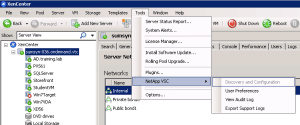
It’s really nice that you can do most of the config from the XenCenter console! I’m right now doing the Cisco UCS and XenDesktop lab here at Synergy and playing around with it and it’s neat! Once the plugin is installed you can interact directly with it from the XenCenter console.
Here you can configure the preferences in a simple way (even though the User Preference console/plugin isn’t the coolest looking tool)!

UCS and XenDesktop – Best Practises guide #Cisco #UCS #XenDesktop #VXI
I must admin that the Cisco, NetApp and Citrix story around providing a great offering around a complete server hardware, storage and networking solution!
I’m currently attending the 5h SYNBCN12-614W-Platform training on XenDesktop with Cisco Unified Computing System and NetApp session here and I must say that I like the offering due to the broad capabilities of the products included in the solution.
I think that one of the real added values that companies will like is that you have ONE (1) support contact (Cisco) for the whole solution, then Cisco wodk with the others to solve any potential issue etc.
And while playing around here the trainer also mentioned this best practise guide, and it looks good;
Additional info about the Cisco VXI – Desktop Virtualization can be found here.
Cheers!
//Richard
Issue 23 – The XenDesktop Experience A Technical Publication for XenDesktop Customers
Ok, Citrix has again released the XenDesktop technical publication, have a look at it!
Example topics include;
- High Availability for Citrix XenDesktop and Citrix XenApp – Planning Guide
- How to Tighten the Security of Windows Desktops
- Tackling Windows Migration
Continue reading here!
//Richard
Please contribute – What do we expect from Citrix? – Citrix community enhancement list
Ok, there are a lot of things that I think we all expect Citrix to deliver now in Barcelona when Synergy soon kicks off! But so far I’ve not seen someone that has been combining a community list yet…
And the most important part I feel is that I get more and more information from companies out there that have enhancement requests and issues that they have a hard time expressing and getting into Citrix. The larger enterprises can of course through their channels get more information and also make their voice heard, but the SMB’s have a hard time to do so!
So this is my attempt to start a dialogue with all of U out there on what we expect to see from Citrix in the future! I think it would be interesting to see if the items I’m waiting for a change on is aligned with the rest of the community!
So why don’t we all contribute to a list that we all can share and prioritise over time? I can for a start moderate this list if you comment or send me items that you think should be on the list and then I’ll try to make sure that people within Citrix get the items and I’ll try to follow up! Of course we need help from the CTP’s (just to be clear; I’m not a CTP so don’t get me wrong here) and others as well to put pressure and assist in the governance of this activity.
So this is my first list of items that I think that we can build upon… It’s a first draft and far from the total number of items are there so bear with me! 😉
Please comment below to have your item(s) added to the list and let’s make a change!
| ID | Product/Area | Enhancement request/Issue | Status |
| 1 | Licensing | Ensure that all products supports the license server (NetScaler etc.) | Not fullfilled |
| 2 | Monitoring & Reporting | Ensure that you can get historical concurrent user reports that spans across ALL products (NetScaler/AG, XenApp, XenDesktop etc.) | Not fullfilled |
| 3 | Monitoring & Reporting | Ensure that Citrix provides an end-2-end monitoring and reporting service for the whole Citrix stack. This to ensure that delivery organizations can deliver reports like “Service Availability in %” over time that includes all service components (NetScaler AGEE VIP, StoreFront/WI, PVS/MSC, XenServer, XenApp/VDA, Profile Server, etc. If Citrix isn’t going to do this; then please point on a product that does the job. | Not fullfilled |
| 4 | Monitoring & Reporting | Provide a monitoring solution to ensure health and best practise configurations of all products involved in a traditional “XenDesktop” stacked service. | Not fullfilled |
| 5 | Cross-product | Improve your testing!! There have been to many issues with updates to products in the “Citrix stack” that has caused issues in others, like update to XenServer that caused PVS issues, or updates to a specific NetScaler feature that caused others to fail. | Not fullfilled |
| 6 | Cross-product | Create an central update service for all products that can inform the admin about updates not applied or if components aren’t in synch in terms of SW versions etc. | Not fullfilled |
| 7 | Cross-product | Ensure that the end-user look & feel are the same across the products used in the stack (NetScaler AGEE login page, Web Interface/StoreFront, Receiver etc..). This should not require admins to do and should be a design principle. | Not fullfilled |
| 8 | Cross-product | Come on, simplify the administration of the products in the stack = reduce the number of consoles! | Not fullfilled |
| 9 | AppController | Multi-domain support | Not fullfilled |
| 10 | AppController | Support for multiple setups that can synch the DB. This to ensure that you can have an HA pair setup for instance in Europé and one in the North Americas and have the end-user be logged in against both and have their subscriptions etc follow them (as well as of course reporting, monitoring etc. etc.) | Not fullfilled |
| 11 | AppController | Support for really large AD domains with LARGE # of AD users and AD groups | Not fullfilled |
| 12 | AppController | Support for AD domain structure where the BASE DN is different to where AD users and the AD security groups you want to use for roles | Not fullfilled |
| 13 | EdgeSight | Ensure that EdgeSight or equivalent end-user monitoring and reporting is integrated and that works on both XenApp and XenDesktop VDA’s and that doesn’t increase the IOPS with rediciolous numbers… | Not fullfilled |
| 14 | NetScaler | Create SDX platform to run on all MPX appliances, for more info why see; NetScaler MPX vs. SDX dilemma; https://richardegenas.com/2012/10/03/netscaler-mpx-vs-sdx-dilemma/ | Not fullfilled |
| 15 | NetScaler | Provide out of the box integration with the Single Sign-On product (former CPM) so that Account Self-Service can be made directly from AGEE VIP login page. | Not fullfilled |
| 16 | NetScaler | Add support for AG session policies so that ICA proxy can be turned on for specific published apps and desktops and not per session. This for situations where you might have one app or desktop that sits behind an AGEE and others don’t. | Not fullfilled |
| 17 | NetScaler | The NetScaler/Access Gateway HTML/GUI pages used shall be able to be customized per AGEE/AAA Virtual Server. Today they are global pages so that specific modifications/customizations cannot be made and you have to buy an additional NetScaler unless major customizations are done and then life-cycle management becomes an issue. | Not fullfilled |
| 18 | NetScaler | Change so that you can specify different Authentication policies and requirements mapped to Session policies instead of to a Virtual Server, AAA group etc. This could then provide a way so that you could offer ICA proxy mode with single auth and two-factor if you launch/select to open an SSL VPN tunnel | Not fullfilled |
| 19 | NetScaler | It would be good if you on the Receiver could select what authentication you want to perform upon login and not just at setup of the Account. That would mean that you could pass that info the the NS VS and then in AGEE handle that to the authentcaiton policies and session policies. Then a user that has forgotten a hardtoken could still get access but only in ICA proxy mode and have all virtual channels disabled without having to have multiple accounts in the Receiver and admin doesn’t need multiple NS AGEE VS. | Not fullfilled |
| 20 | Merchandising Server | Ensure that it supports larger AD environments and multi-domain support | Not fullfilled |
| 21 | Merchandising Server | Create a central DB for config etc or ensure that MS is migrated into SF asap. | Not fullfilled |
| 22 | Provisioning Services | Improved/simplified support/update functionality for when you use KMS licensing | Not fullfilled |
| 23 | Provisioning Services | Create REAL update msp or msi files for updates, you can’t require admins to go in and replace DLL-files etc in 2012 | Not fullfilled |
| 24 | Provisioning Services | Implement replication of vDisk files (diff-files) etc so that it’s automated within the PVS solution so that you don’t have to rely on DFS-R etc. | Not fullfilled |
| 25 | ShareFile | Ensure that encryption on local devices are available for all device types and OS’s (iOS, Android, Windows Phone, Win XP/7/8, Linux, OS X) | Not fullfilled |
| 26 | ShareFile | Design the product so that you could leverage public storage providers for your storage but encrypt it using your own PKI service and proxy traffic to it through the Storage Center server(s) without having to invest in in-house storage solutions and reduce CAPEX. | Not fullfilled |
| 27 | ShareFile | Design the solution so that you can configure the plygin/Receiver functionality when it comes to StoreFront on groups/roles instead of just for the whole account. | Not fullfilled |
| 28 | Storefront | Support for multiple setups that can synch the DB. This to ensure that you can have an HA pair setup for instance in Europé and one in the North Americas and have the end-user be logged in against both and have their subscriptions etc follow them (as well as of course reporting, monitoring etc. etc.) | Not fullfilled |
| 29 | Storefront | Simplify configuration and branding of the StoreFront for Web sites like most other providers have and they had in Web Interface | Not fullfilled |
| 30 | Storefront | Add all features that where available in Web Interface | Not fullfilled |
| 31 | StoreFront | Design the product to allow the user to select whether he/she can group apps and desktops into folders or tabs in StoreFront for Web | Not fullfilled |
| 32 | Receiver | Ensure that email-enrollment to StoreFront stores can somehow support multidomain support (like if you have multiple users having the same email-address; name@company.com can be linked to different AD domains | Not fullfilled |
| 33 | Receiver | Corporate branding for the Receiver, logo, text etc. | Not fullfilled |
| 34 | Receiver | Ensure that all Receivers have the same look & feel and functionality. Like the secondary and primary password field names should be the same on a Mac and a Windows client, as well as other features. | Not fullfilled |
| 35 | Receiver | Add so that Receiver passes DOMAINNAME to NetScaler/AG VS so that it can be used to determine which AD domain to authenticate with. In todays version you have to either make one VS per domain or cascade through multiple domains on the same VS. And cascading is available as a workaround but triggers failed logins against AD and is not that nice and security/AD teams are not that happy… | Not fullfilled |
| 36 | XenDesktop | Support for Linux VDA’s (Ubuntu for example) | Not fullfilled |
| 37 | XenApp | Support for Linux Terminal Servers (Ubuntu for example) | Not fullfilled |
I’ll post an excel-spreadsheet as well for download soon, and then let’s see if there is an interest or not! 😉
Cheers!
//Richard
Citrix Knowledge Center Top 10 – September 2012
Citrix has released the September Top 10 list, ensure you have a look at it!
Citrix Support is focused on ensuring Customer and Partner satisfaction with our products.
One of our initiatives is to increase the ability of our Partners and Customers to leverage self-service avenues via our Knowledge Center.
Find below the Citrix Knowledge Center Top 10 for September 2012.
Top 10 Technical Articles
| Article Number | Article Title |
|---|---|
| CTX129229 | Recommended Citrix and Microsoft Hotfixes for XenApp 6 and Windows Server 2008 R2 |
| CTX129082 | Application Launch Fails with Web Interface using Internet Explorer 9 |
| CTX132875 | Citrix Receiver Error 2320 |
| CTX804493 | Users Prompted to Download ICA File, Launch.ica, Instead of Launching the Connection |
| CTX105793 | Error: Cannot connect to the Citrix server. Protocol Driver Error |
| CTX101644 | Seamless Configuration Settings |
| CTX101810 | Communication Ports Used By Citrix Technologies |
| CTX127030 | Citrix Guidelines for Antivirus Software Configuration |
| CTX133037 | Citrix Receiver 3.2 – Issues Fixed in This Release |
| CTX115637 | Citrix Multi-Monitor Configuration Settings and Reference |
Continue reading here!
//Richard
READ THIS – Demystifying Microsoft virtual desktop licensing: SA vs. VDA vs. CDL
Why can’t you vendors out there make licensing less complex and more “logical”…??
“When it comes to virtual desktop infrastructure, administrators have a lot of choices. You may have wondered about the differences between VDI software options, remote display protocols or all the licenses out there. In this series, we tackle some of the biggest head-scratchers facing VDI admins to help you get things straight.”
Continue reading this great article here!
//Richard
Reference Architecture and Deployment Guide – Citrix XenDesktop 5.5 Built on Cisco UCS B-Series Blade Servers
For you that are thinking of looking at Cisco UCS and XenDesktop; have a look at this reference architecture document from Cisco…
“Citrix XenDesktop 5.5 Built on Cisco UCS B-Series Blade Servers, Cisco Nexus 5000 Series Switches, and VMware ESXi 5.0: Reference Architecture and Deployment Guide”
Download here!
//Richard
Lync 2013 client preview for VDI/Hosted Virtual Desktop environments
This is an update in the right direction for getting all Lync features to work in a hosted environment! But where are we on this topic of getting the collaboration features etc. to our end-users in a good way to the “Any Device” and “Anywhere” or BYOD if that’s what you wanna call it?
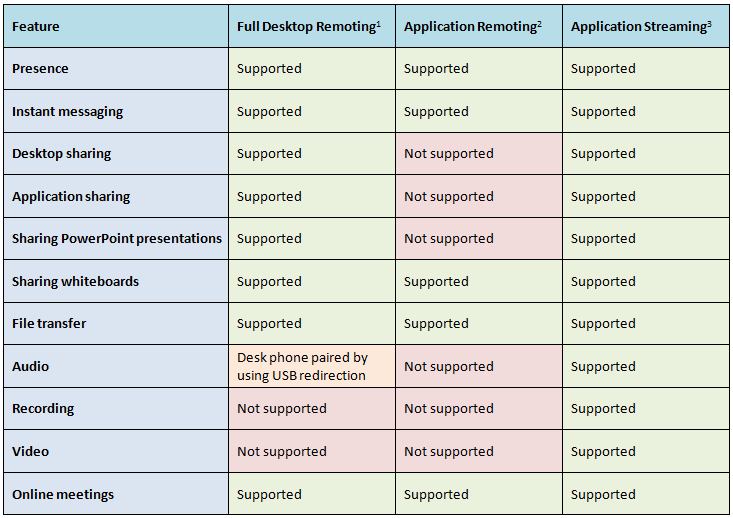
Before there has been a lot of issues with running Lync and what’s supported feature-wise depending on where you ran Lync, what protocol you where accessing it over and how Lync was presented (either as published desktop or as a published app). And this had it’s challenges for companies that for instance wanted to go to a BYOD model where the end-point device the user was sitting on wsn’t managed and didn’t allowed Lync to be installed and where those users then were relying on their XenApp or XenDesktop environment. And then there are features that aren’t supported or let’s say; didn’t work that well and really loaded the host server.
The table below is from a great Microsoft blog post by Jesper Osgaard where he compares the features of Lync in a virtualized environment;
What did Citrix do about it? Well first they released the HDX Realtime Optimization Pack for Microsoft Lync to address these issues and to ensure improved Lync functionality. And I must give Citrix credit for adding support for Linux directly!
Hyper-V 2008 R2 Planning Guide for XenDesktop 5.6 Now Available
Ok, another great blog post from Citrix!
“A key advantage of XenDesktop is that it works with three of the most common virtualization products on the market today – Citrix XenServer, Microsoft Hyper-V and VMware vSphere. However, each of these Hypervisors has a different architecture and feature set. Since each XenDesktop design will vary according to the Hypervisor chosen, we’ve created three separate Planning Guides:
- CTX134944: XenDesktop Planning Guide – Integration with Microsoft Hyper-V
- CTX132110: XenDesktop Planning Guide – Integration with Citrix XenServer
- CTX132166: XenDesktop Planning Guide – Integration with VMware vSphere
It’s been a while since the first XenDesktop Planning Guide for Hyper-V was released and we’ve learned a lot in that time. That’s why Ed Duncan and I have just finished a complete rewrite of the Hyper-V Planning Guide (CTX134944) with help from Alex Balcanquall, Michael Cooper, Tony Sanchez and Frank Anderson. In the new release, we’ve added and revised a number of key design decisions for Hyper-V, including:
- Which edition of Hyper-V should I choose? The pros and cons of each edition are discussed and recommendations are provided on which edition should be used to host XenApp servers, virtual desktops and infrastructure servers.
- How many physical networks will I need to attach to my hosts? Details are provided on the typical physical networks requirements for a Hyper-V host supporting XenDesktop including recommendations on traffic separation and which networks should be teamed.
- Which virtual machines should be hosted on a Failover Cluster? Recommendations are given based on whether the virtual machines are infrastructure servers, dedicated desktops, pooled desktops or XenApp servers.
- Should I enable Dynamic Memory? The Planning guide will explore the benefits from enabling Dynamic Memory and provide recommendations on how to optimize this technology.
- Should I use Provisioning Services (PVS) or Machine Creation Services (MCS) with Hyper-V? The Planning Guide also highlights important considerations when deciding between Provisioning Services or Machine Creation Services.”
Read more here!
//Richard



 The IT Melting Pot!