Archive
GREAT VIDEO – #Citrix #XenDesktop vs. #VMware #Horizon #View installation video
This is really funny! Have a look at this video to see how you can compare a XenDesktop and a Horizon View installation side-by-side!
And another thing that is kind of funny is that VMware still compares Horizon View with XenDesktop 5.6: https://www.vmware.com/files/pdf/techpaper/VMware-View-vs-Citrix-XenDesktop-Datasheet.pdf
//Richard
VMware acquires AirWatch! – #EMM, #MDM, #BYOD, #VMware, #AirWatch
This is really interesting! I’m not that surprised though, it was about time VMware did something!
I must agree with a lot of people who have written about this, they are really going for a leader! So they mean business! Will be fun to see how well the can integrate this into their offerings and how that will look like.
VMware buys AirWatch for $1.54 billion, acquires mobility strategy
VMware will acquire AirWatch, a mobile device management company, in a $1.17 billion cash deal that will give the virtualization software provider a play in mobility. VMware will also pay $365 million in installment payments and unvested stock options.

Mobile device management has been a hot sector desperately in need of consolidation given there are more than 100 vendors. Large enterprises increasingly want mobile device management put together with content management and collaboration. VMware’s acquisition follows IBM’s purchase of FiberLink and Citrix’s acquisition of Xenprise in 2013.
VMware’s spin is that AirWatch will give it a foothold in mobility as well as its end-user computing strategy, which revolves around desktop virtualization and delivering enterprise apps to tablets and smartphones.
Here’s Gartner’s Magic Quadrant on the sector.

According to VMware, AirWatch will continue to be led by CEO John Marshall. AirWatch will be lumped into VMware’s end-user computing group, which… continue reading here!
VMWare Announces Definitive Agreement to Acquire AirWatch
Acquisition will Provide Customers with the Most Complete Solution to Manage Users, Devices and Applications across Desktop and Mobile Environments.
PALO ALTO, Calif., January 22, 2014 – VMware, Inc. (NYSE: VMW), the global leader in virtualization and cloud infrastructure, and AirWatch today announced that they have signed a definitive agreement under which VMware will acquire AirWatch, the leading provider of enterprise mobile management and security solutions. VMware will acquire AirWatch for approximately $1.175B in cash and approximately $365M of installment payments and assumed unvested equity. The AirWatch team will continue to report to founder and chief executive officer John Marshall as part of VMware’s End-User Computing group, led by Sanjay Poonen, EVP and GM. Alan Dabbiere, AirWatch’s cofounder and chairman, will be overseeing a new AirWatch operating board which will report to Pat Gelsinger, VMware chief executive officer.
“AirWatch provides best-in-class, secure, enterprise-mobile management to thousands of businesses around the world,” said Pat Gelsinger, chief executive officer, VMware. “With this acquisition VMware will add a foundational element to our end-user computing portfolio that will… continue reading here!
//Richard
#Nutanix Triumphs at V3 Technology Awards 2013 for Best Virtualisation Product – #IaaS
This is great! A great product takes another award!!! 😉
V3 Readers Award Nutanix with Prestigious Industry Recognition in Highly Competitive Category
Nutanix also won the Best of VMworld 2013 Gold Award for Private Cloud Computing!
LONDON, December 3, 2013 – Nutanix, the leading provider of hyper-efficient, massively scalable and elegantly simple datacentre infrastructure solutions, has been awarded for its continuing innovation in optimising datacentre infrastructure at the V3 Technology Awards 2013. During a ceremony at the Waldorf Hilton Hotel, the company was awarded Best Virtualisation product, beating a host of well respected and larger, more established organisations in the virtualisation market.
V3.co.uk is a leading source of news and analysis for technology professionals, written by a team of expert IT journalists in the UK and Silicon Valley. The awards were hotly contested this year, with more than 450 entries from 150 companies.
“It’s great to see a new company like Nutanix being recognised at the V3 Technology Awards, among the industry giants. It wasn’t an easy task whittling down the hundreds of entries to create the shortlist, and then V3 readers voted in their thousands for their favourites, making this a significant achievement and a well-deserved win. Well done Nutanix!” said Madeline Bennett, Editor, V3 and The INQUIRER.
Alan Campbell, Regional Director of Western Europe at Nutanix, commented on the success: “Nutanix is a company that is constantly innovating and striving to provide the best platform for its customers, so this recognition by a highly respected publication is a testament to the hard work of our team. Virtualisation is a rapidly evolving technology which we are proud to be at the forefront of and to receive an award in the UK, a key market for us, is an honour.
As the fastest growing enterprise…
Continue reading here!
//Richard
#Gartner analyst slams #OpenStack, again – #IaaS
Good article and I must agree that OpenStack has quite a long way to go before the “average” enterprise embraces it…
OpenStack still has maturing to do before it’s really ready for the enterprise, analyst says
Network World – Gartner analyst Allessandro Perilli recently attended his first summit for the open source cloud platform OpenStack and he says the project has a long way to go before it’s truly an enterprise-grade platform.
In a blog post reviewing his experience, the analyst – who focuses on studying cloud management tools – says that OpenStack is struggling to increase its enterprise adoption. Despite marketing efforts by vendors and favorable press, enterprise adoption remains in the very earliest stages, he says.
Don’t believe the hype generated by press and vendor marketing: OpenStack penetration in the large enterprise market is minimal.— Gartner analyst Alessandro Perilli

Sure there are examples like PayPal, eBay and Yahoo using OpenStack. But these are not the meat and potatoes types of enterprise customers that vendors are looking to serve. Why? He outlines four reasons, most of which are related to the process and community nature of the project, and less around the technical maturity of it. By the way, this is not the first time a Gartner analyst has thrown cold water on the project.
[EARLIER CRITICISMS FROM GARTNER: Gartner report throws cold water on OpenStack hype]
Lack of clarity about what OpenStack does
There is market confusion about exactly what OpenStack is, he says. It is an open source platform that can be assembled together to build a cloud. It, by itself, is not a cloud though just by downloading and installing it. OpenStack requires some heavy lifting to turn the code into an executable cloud platform, which is why dozens of companies have come out with distributions or productized versions of OpenStack code. But, the code itself is not a competitor to cloud platforms offered by vendors like VMware, BMC, CA or others. Read more…
Single File Restore – Fairy Tale Ending Going Down History Lane – via @Nutanix and @dlink7
Great blog post by Dwayne Lessner!
If I go back to my earliest sysadmin days where I had to restore a file from a network share, I was happy just to get the file back. Where I worked we only had tape and it was crapshoot at the best of times. Luckily, 2007 brought me a SAN to play with.
 The SAN made it easier for sure to go back into time and find that file and pull it back from the clutches of death by using hardware based snapshots. It was no big deal to mount the snapshot to the guest but fighting with the MS iSCSI initiator got pretty painful, partly because I had a complex password for the CHAP authentication, and partly because clean-up and logging out of the iSCSI was problematic. I always had ton of errors, both in the windows guest and in the SAN console which caused more grief than good it seemed.
Shortly after the SAN showed up, VMware entered my world. It was great that I didn’t have to mess with MS iSCSI initiators any more but it really just moved my problem to the ESXi host. Now that VMware had the LUN with all my VMs, I had to worry about resignatureing the LUN so it wouldn’t have conflicts with the rest of production VMs. This whole process was short lived because we couldn’t afford all the space the snapshots were taking up. Since we had to use LUNS we had to take snapshots of all the VMs even though there were a handful that really need the extra protection. Before virtualization we were already reserving over 50% of the total LUN space because snapshots were backed by large block sizes and ate through space. Due to the fact that we had to snapshot all of the VMs on the LUN we had to change the snap reserve to 100%. We quickly ran out of space and turned off snapshots for our virtual environment.
When a snapshot is taken on Nutanix, we don’t copy data, nor do we copy the meta-data. The meta-data and data diverge on a need basis; as new writes happen against the active parent snapshot we just track the changes. Changes operate at the byte level which is a far cry from the 16 MB I had to live with in the past.
Due to the above-mentioned life lessons in LUN-based snapshots, I am very happy to show Nutanix customers the benefits of per-VM snapshots and how easy it to restore a file.
 To restore a file from a VM living on Nutanix you just need to make sure you have a protection domain set up with a proper RPO schedule. For this example, I created a Protection Domain called RPO-High. This is great as you could have 2,000 VMs all on one volume with Nutanix. You just slide over what VMs you want to protect; in this example, I am protecting my FileServer. Note you can have more than one protection domain if you want to assign different RPO to different VMs. Create a new protection domain and add 1 VM or more based on the application grouping.
#Gartner report – How to Choose Between #Hyper-V and #vSphere – #IaaS
The constant battle between the hypervisor and orchestration of IaaS etc. is of course continuing! But it is really fun I must say that Microsoft is getting more and more mature with it’s offerings in this space, great job!
One of the things that I tend to think most of is the cost, scalability and flexibility of the infrastructure that we build and how we build it, I often see that we tend to do what we’ve done for so many years now. We buy our SAN/NAS storage, we buy our servers but lean towards Blade servers though we think that’s the latest and coolest, and then we try to squeeze that into some sort of POD/FlexPods/UCS or whatever we like to call it to find our optimal “volume of Compute, Network and Storage” that we can scale. But is this scalable like the bigger cloud players like Google, Amazon etc.? Is this 2013 state of the art? I think that we’re just fooling ourselves a bit and build whatever we’ve done for all these years and don’t really provide the business with anything new… but that’s my view… I know what I’d look at and most of you that have read my earlier blog posts know that I love the way of scaling out and doing more like the big players using something like Nutanix and ensure that you choose the right IaaS components as a part of that stack, as well as the orchestration layer (OpenStack, System Center, CloudStack, Cloud Platform or whatever you prefer after you’ve done your homework).
Back to the topic a bit, I’d say that the hypervisor is of no importance anymore, that’s why everyone if giving it away for free or to the open source community! Vendors are after the more IaaS/PaaS orchestration layer and get into that because if they get that business then they have nested their way into your business processes, that’s where ultimately that will deliver the value as IT services in an automated way once you’ve got your business services and processes in place, and then it’s harder to make a change and they will live fat and happy on you for some years to come! 😉
True Scale Out Shared Nothing Architecture – #Compute, #Storage, #Nutanix via @josh_odgers
This is yet another great blog post by Josh! Great work and keep it up! 😉
I love this statement:
I think this really highlights what VMware and players like Google, Facebook & Twitter have been saying for a long time, scaling out not up, and shared nothing architecture is the way of the future.
At VMware vForum Sydney this week I presented “Taking vSphere to the next level with converged infrastructure”.
Firstly, I wanted to thank everyone who attended the session, it was a great turnout and during the Q&A there were a ton of great questions.
I got a lot of feedback at the session and when meeting people at vForum about how the Nutanix scale out shared nothing architecture tolerates failures.
I thought I would summarize this capability as I believe its quite impressive and should put everyone’s mind at ease when moving to this kind of architecture.
So lets take a look at a 5 node Nutanix cluster, and for this example, we have one running VM. The VM has all its data locally, represented by the “A” , “B” and “C” and this data is also distributed across the Nutanix cluster to provide data protection / resiliency etc.

So, what happens when an ESXi host failure, which results in the Nutanix Controller VM (CVM) going offline and the storage which is locally connected to the Nutanix CVM being unavailable?
Firstly, VMware HA restarts the VM onto another ESXi host in the vSphere Cluster and it runs as normal, accessing data both locally where it is available (in this case, the “A” data is local) and remotely (if required) to get data “B” and “C”.

Secondly, when data which is not local (in this example “B” and “C”) is accessed via other Nutanix CVMs in the cluster, it will be “localized” onto the host where the VM resides for faster future access.
It is importaint to note, if data which is not local is not accessed by the VM, it will remain remote, as there is no benefit in relocating it and this reduces the workload on the network and cluster.
The end result is the VM restarts the same as it would using traditional storage, then the Nutanix cluster “curator” detects if any data only has one copy, and replicates the required data throughout the cluster to ensure full resiliency.
The cluster will then look like a fully functioning 4 node cluster as show below.

The process of repairing the cluster from a failure is commonly incorrectly compared to a RAID pack rebuild. With a raid rebuild, a small number of disks, say 8, are under heavy load re striping data across a hot spare or a replacement drive. During this time the performance of everything on the RAID pack is significantly impacted.
With Nutanix, the data is distributed across the entire cluster, which even with a 5 node cluster will be at least 20 SATA drives, but with all data being written to SSD then sequentially offloaded to SATA.
The impact of this process is much less than a RAID…
Continue reading here!
//Richard
Solving the Compute and Storage scalability dilemma – #Nutanix, via @josh_odgers
The topic of Compute, Network and STORAGE is a hot topic as I’ve written in blog posts before this one (How to pick virtualization (HW, NW, Storage) solution for your #VDI environment? – #Nutanix, @StevenPoitras) … and still a lot of colleagues and customers are struggling with finding better solutions and architecture.
How can we ensure that we get the same or better performance of our new architecture? How can we scale in a more simple and linear manner? How can we ensure that we don’t have a single point of failure for all of our VM’s etc..? How are others scaling and doing this in a better way?
I’m not a storage expert, but I do know and read that many companies out there are working on finding the optimal solution for Compute and Storage, and how they can get the cost down and be left with a more simple architecture to manage…
This is a topic that most need to address as well now when more and more organisations are starting to build their private clouds, because how are you going to scale it and how can you get closer to the delivery that the big players provide? Gartner even had Software-Defined-Storage (SDS) as the number 2 trend going forward: #Gartner Outlines 10 IT Trends To Watch – via @MichealRoth, #Nutanix, #VMWare
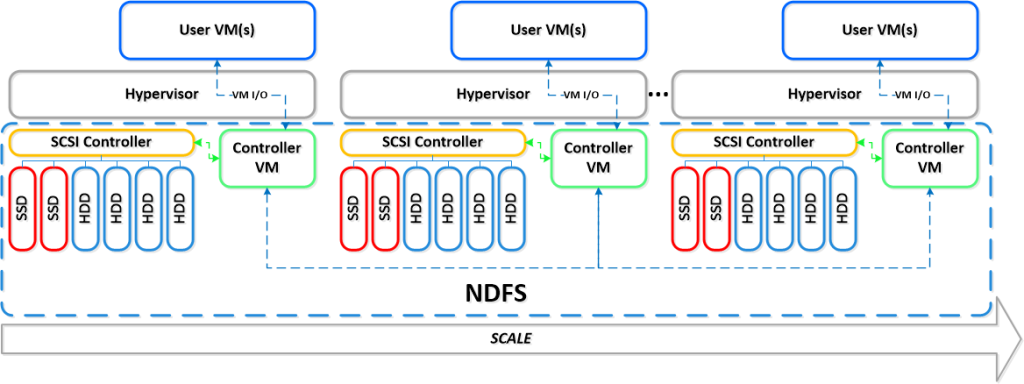
Right now I see Nutanix as the leader here! They rock! Just have a look at this linear scalability:
If you want to learn more how Nutanix can bring great value please contact us at EnvokeIT!
For an intro of Nutanix in 2 minutes have a look at these videos:
Overview:
#Gartner Outlines 10 IT Trends To Watch – via @MichealRoth, #Nutanix, #VMWare
This is also a good analysis I must say, I think that they are spot on! Even though I think that most companies haven’t addressed the whole Mobility aspect of going away from “managing devices” yet, there are a lot of “BYOD” strategies and solutions that companies still need to work on….
And of course I see a great opportunity to transform and build new “cloud” services/datacenters as well and do it in a more up-to-date, agile, scalable and simple way than what we’ve done over all these years. Stop building the old legacy architecture of Compure, Network and Storage and see what the market leaders of IaaS and PaaS are doing. One of the great players here is of course Nutanix as I see it (contact EnvokeIT if you need more info about this great product)!
Gartner Inc. offered a glimpse of 10 trends for IT professionals to pay attention to over the next five years.
The trends were discussed in a Thursday Webinar by David J. Cappuccio, a research vice president at Gartner. He noted that IT pros are busy enough with daily operations, with “74 percent” of IT budgets devoted to those concerns. Still, he contended that there are lots of new technologies and trends that will have an impact on IT departments.
Gartner expects these trends will affect IT over the next five years:
- “Software-defined networks
- “Software-defined storage
- “Hybrid cloud services
- “Integrated systems
- “Applications acceleration
- “The Internet of things
- “Open Compute Project
- “Intelligent datacenters
- “IT demand
- “Organizational entrenchment and disruptions”
End user expectations are affecting IT. New workers getting out of college are expecting access to everything all of the time, from any device, from anywhere, Cappuccio said. They typically own between three and four devices today, he added.
Software-defined networking (SDN) came into general awareness about two years ago, expecially after SDN pioneer Nicira came out of stealth mode, Cappuccio said. Nicira’s idea was to create a software stack that would manage the real-world physical network. The concept resonated well with the marketplace, and Nicira was bought by VMware in a $1.4 billion purchase. SDN represents a new way to operate networks, which can be configured…
Continue reading here!
//Richard
How to pick virtualization (HW, NW, Storage) solution for your #VDI environment? – #Nutanix, @StevenPoitras
Here we are again… a lot of companies and Solution Architects are scratching their heads thinking about how we’re going to do it “this time”.
Most of you out there have something today, probably running XenApp on your VMware or XenServer hypervisor with a FC SAN or something, perhaps provisioned using PVS or just managed individually. There is also most likely a “problem” with talking to the Storage team that manage the storage service for the IaaS service that isn’t built for the type of workloads that XenApp and XenDesktop (VDI) requires.
So how are you going to do it this time? Are you going to challenge the Storage and Server/IaaS service and be innovative and review the new cooler products and capabilities that now exists out there? They are totally changing the way that we build Virtual Cloud Computing solutions where; business agility, simplicity, cost savings, performance and simple scale out is important!
There is no one solution for everything… but I’m getting more and more impressed by some of the “new” players on the market when it comes to providing simple and yet so powerful and performing Virtual Cloud Computing products. One in particular is Nutanix that EnvokeIT has partnered with and they have a truly stunning product.
But as many have written in many great blog posts about choosing your storage solution for your VDI solution you truly need to understand what your service will require from the underlying dependency services. And is it really worth to do it the old way? You have your team that manages the IaaS service, and most of the times it just provides a way for ordering/provisioning VM’s, then the “VDI” team leverages that one using PVS or MCS. Some companies are not even where they can order that VM as a service or provision it from the Image Provisioning (PVS/MCS) service, everything is manual and they call it a IaaS service… is it then a real IaaS service? My answer would be now… but let’s get back to the point I was trying to make!
This HW, Hypervisor, Network, Storage (and sometimes orchestrator) components are often managed by different teams. Each team are also most of the times not really up to date in terms of understanding what a Virtualization/VDI service will require from them and their components. They are very competent in understanding the traditional workload of running a web server VM or similar, but not really dealing with boot storms from hundreds to thousands of VDI’s booting up, people logging in at the same time and the whole pattern of IOPS that is generated in these VM’s “life-cycle”.
This is where I’d suggest everyone to challenge their traditional view on building Virtualization and Storage services for running Hosted Shared Desktop (XenApp/RDS) and Hosted Virtual Desktop (VDI/XenDesktop) on!
You can reduce the complexity, reduce your operational costs and integrate Nutanix as a real power compute part of your internal/private cloud service!
One thing that also is kind of cool is the integration possibilities of the Nutanix product with OpenStack and other cloud management products through its REST API’s. And it supports running both Hyper-V, VMware ESXi and KVM as hypervisors in this lovely bundled product.
If you want the nitty gritty details about this product I highly recommend that you read the Nutanix Bible post by Steven Poitras here.



 The IT Melting Pot!