Archive
10 Mobile Device Management Leaders That Help IT Control #BYOD, #Gartner, #Citrix, #MDM
Consumers love their smartphones and tablets, so it should come as no surprise that they want to use their devices at work. The pressure to develop and deploy a bring-your-own-device (BYOD) policy is on and coming from every direction, including the ‘C’ suite of executives who tend to be especially keen on using smartphones and tablets for their work.
Managing devices in a BYOD environment is no small feat, and the right mobile device management (MDM) product is a key component in making it work. Here are 10 leading MDM vendors in the market today, drawn from the leaders and visionaries in Gartner’s 2013 Magic Quadrant for Mobile Device Management Software.
Magic Quadrant

#BYOD: From optional to mandatory by 2017, says #Gartner
I agree with this great article and the analysis made by Gartner.
Bring-your-own-device (BYOD) has for some time been gaining traction in the workplace, as not only a way of freeing up IT costs but also liberalizing workers from being virtually chained, clunky, aging machines at their desks.
But latest research from Gartner suggests that by 2017, half of employers may impose a mandatory BYOD policy — requiring staffs to bring their own laptop, tablet and smartphone to work.
As an optional policy, workplaces still have an IT fallback option, but many are choosing to bring their own tablets and smartphones to work in order to work more effectively using the technology they feel more comfortable with.
Some interesting tidbits from the research:
- 38 percent of companies expect to stop providing workplace devices to staff by 2016. (PCs, such as desktops and laptops, are included in the definition of BYOD.)
- BYOD is most prevalent in midsize and larger enterprises, often generating between $500m-$5bn in revenue per year, with 2,500-5,000 employees on the roster.
- BRIC nations, such as India, China, and Brazil, will most likely already be using a personal device — typically a “standard mobile phone” — at work.
- Meanwhile, companies in the U.S. are more likely to allow BYOD than those in Europe (likely due to stronger data protection rules, see below).
- Around half of all BYOD programs provide a partial reimbursement, while full reimbursement costs “will become rare.”
- Gartner vice president David Willis says companies should “subsidize only the service plan on a smartphone.”
But there’s a problem within. Those who have yet to adopt a BYOD policy often generally cite one of two good reasons (or both): interoperability and…
Continue reading here!
//Richard
The Business Case for Mobility Services – #Mobility, #BYOD, #Citrix, #Gartner
I must agree that all these mobile devices and BYOD etc. are putting challenges as well as opportunities on businesses. But there are not many out there with a clear strategy and business view on how to grasp the opportunities and WHY. Do you have a clear strategy on how to address for instance BYOD?
This video explores the business case for adopting and integrating Mobility Services into a Solution Provider’s deliverables.
And what’s also interesting in this topic of discussion is the Gartner Hype Cycle of Innovation.
This was the hype cycle for year 2012

Image Source :Givinginadigitalworld
//Richard
Magic Quadrant for Application Delivery Controllers – #Citrix, #NetScaler, #F5
The application delivery controller has evolved into a key component of the data center architecture, and enterprises should evaluate ADCs based on how they integrate with this architecture and support more-advanced features, such as user and traffic control and monitoring.

Market Definition/Description
Application delivery controllers (ADCs) provide functions that optimize enterprise application environments. The market evolved from the load-balancing systems that were specifically developed to ensure the availability and scalability of websites. Enterprises use ADCs to optimize reliability, end-user performance, data center resource use and security for a variety of enterprise applications.
Magic Quadrant

Source: Gartner (October 2012)
Vendor Strengths and Cautions
A10 Networks
A10 continues to gain market share and brand awareness, especially in Asia, and it is aggressively targeting the North American market. Its product development has placed focus on developing a scalable high-performance platform with a strong feature set but a more limited focus on establishing a data center architectural vision. While strong in its product focus, A10 has demonstrated more limited innovation and still has a more narrow feature support than leading vendors. A10 is a good choice for enterprises seeking a cost-effective…
Continue reading here!
//Richard
Tablets are crushing PC sales, Gartner finds
Don’t blame Windows 8 or the economy for poor PC sales, analyst says
People are buying tablets to replace old PCs, which explains why PC sales were so dismal over the holidays, according to Gartner.
Small, portable, capable, inexpensive, touchscreen tablets grab sales from low-end PCs and mean that old PCs will not be replaced with new ones, says Mikako Kitagawa, a Gartner principal analyst, and that is a significant change in how PC sales work.
“Whereas as once we imagined a world in which individual users would have both a PC and a tablet as personal devices, we increasingly suspect that most individuals will shift consumption activity to a personal tablet, and perform creative and administrative tasks on a shared PC,” Kitagawa says.
“This transformation was triggered by the availability of compelling low-cost tablets in 2012, and will continue until the installed base of PCs declines to accommodate tablets as the primary consumption device.”
That is the battle Windows 8 is fighting, Gartner says, although the scarcity of Windows 8 touch devices may so far have hampered sales. With new touch machines being promised for later this year, that may help Windows 8 grab a larger share of PC sales but not help the overall number of PCs sold, Gartner says.
Sales were down 4.9% in Q4 2012 compared to Q4 2011, Gartner says, which goes along with IDC numbers from last week, although IDC’s number, 6.4%, is larger. “During the holiday season, consumers no longer viewed PCs as the number one gift item,” Gartner said…
Continue to read here!
//Richard
Magic Quadrant for Endpoint Protection Platforms – #Gartner, #EPP via @rspruijt
Magic Quadrant for Endpoint Protection Platforms
VIEW SUMMARY
The endpoint protection platform provides a collection of security utilities to protect PCs and tablets. Vendors in this market compete on the quality of their protection capabilities, the depth and breadth of features, and the ease of administration.
Market Definition/Description
The enterprise endpoint protection platform (EPP) market is a composite market primarily made up of collections of products. These include:
- Anti-malware
- Anti-spyware
- Personal firewalls
- Host-based intrusion prevention
- Port and device control
- Full-disk and file encryption, also known as mobile data protection
- Endpoint data loss prevention (DLP)
- Vulnerability assessment
- Application control (see Note 1)
- Mobile device management (MDM)
These products and features are typically centrally managed and ideally integrated by shared policies.
DLP, MDM and vulnerability assessment are also evaluated in their own Magic Quadrant or MarketScope analyses. Longer term, portions of these markets will get subsumed by the EPP market, as the personal firewall, host intrusion prevention, device control and anti-spyware markets have in the past. EPP suites are a logical place for convergence of these functions. Indeed, 53% of organizations in a recent Gartner survey1 already use a single vendor for several of these functions, or are actively consolidating products. In particular, mobile data protection is the leading complement to EPP and purchasing decisions regarding the two products are increasingly made together. For most organizations, selecting a mobile data protection system from their incumbent EPP vendors will meet their requirements.
In 2012, the large enterprise EPP market is still dominated by Symantec, McAfee and Trend Micro, which together represent approximately 68% of the total revenue of Magic Quadrant participants. Sophos and Kaspersky Lab are the two other global leaders that are competitive across multiple functions and geographies, and push the combined Leaders quadrant market share to 85%. Despite the introduction of new players, the displacement of incumbents is still a significant challenge in the large enterprise market. The biggest impact of the Magic Quadrant Challengers and Visionaries is to push the dominant market players to invest in new features and functionality (sometimes via acquisitions) to stay ahead, and to keep pricing rational. In the less demanding small and midsize market, competition is more intense. A number of Niche Player solutions are dominant in specific regions.
The total EPP revenue of the Magic Quadrant participants at year-end 2011 was roughly $2.8 billion, up 4% from 2010. We attribute this growth primarily to increased buying of more-expensive suites, offset by lower prices for low-end malware-only solutions. Consequently, EPP revenue growth is more a result of an inflow of revenue from other markets. We anticipate that growth will continue to be in the low single digits in 2013.
Microsoft is the best vendor in a position to challenge the incumbent Leaders, primarily due to attractive pricing in its enterprise agreements. Approximately one-third of enterprise buyers1 indicate they are actively considering Microsoft or plan to do so during their next renewal periods. However, Microsoft’s slow development, the lack of a single unified security management interface and mediocre test results will temper its adoption. Longer term, we believe that increased displacement of Windows endpoints with application-controlled OSs (such as Microsoft WinRT and Apple’s iOS and OS X Mountain Lion) is the biggest market threat. These solutions shift the value proposition of EPP solutions from traditional anti-malware to MDM and data protection capabilities.
Magic Quadrant

Source: Gartner (January 2013)
Vendor Strengths and Cautions
Arkoon Network Security
Arkoon Network Security’s StormShield EPP solution (formerly offered by SkyRecon Systems) is designed as a seamless integrated EPP with a focus on behavioral protection. Arkoon’s Ability to Execute score is hampered by its relatively small market share and limited geographic presence, as well as its still-maturing management capabilities….
Continue reading here!
//Richard
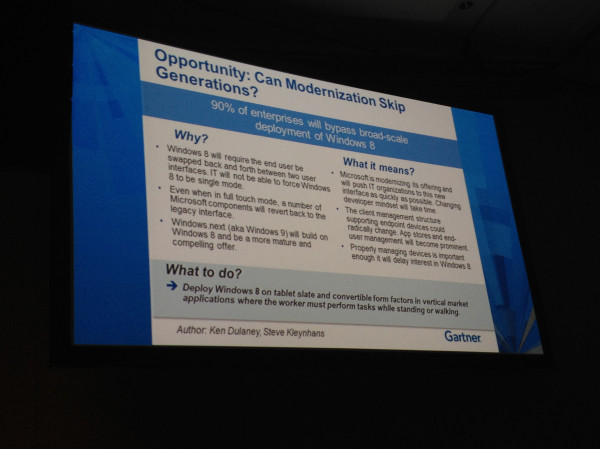
90% of enterprises will bypass broad-scale deployment of Windows 8
This picture/slide is so spot on! I couldn’t agree more! Great work Gartner!
I don’t think that Windows 8 will be adopted on a broader scale… it’s the new “Vista”. Win7 will and is being rolled out and will stay there for a long time as the new “XP”!
Thanks Charlie Isaacs for the picture!
//Richard



 The IT Melting Pot!