Archive
True Scale Out Shared Nothing Architecture – #Compute, #Storage, #Nutanix via @josh_odgers
This is yet another great blog post by Josh! Great work and keep it up! 😉
I love this statement:
I think this really highlights what VMware and players like Google, Facebook & Twitter have been saying for a long time, scaling out not up, and shared nothing architecture is the way of the future.
At VMware vForum Sydney this week I presented “Taking vSphere to the next level with converged infrastructure”.
Firstly, I wanted to thank everyone who attended the session, it was a great turnout and during the Q&A there were a ton of great questions.
I got a lot of feedback at the session and when meeting people at vForum about how the Nutanix scale out shared nothing architecture tolerates failures.
I thought I would summarize this capability as I believe its quite impressive and should put everyone’s mind at ease when moving to this kind of architecture.
So lets take a look at a 5 node Nutanix cluster, and for this example, we have one running VM. The VM has all its data locally, represented by the “A” , “B” and “C” and this data is also distributed across the Nutanix cluster to provide data protection / resiliency etc.

So, what happens when an ESXi host failure, which results in the Nutanix Controller VM (CVM) going offline and the storage which is locally connected to the Nutanix CVM being unavailable?
Firstly, VMware HA restarts the VM onto another ESXi host in the vSphere Cluster and it runs as normal, accessing data both locally where it is available (in this case, the “A” data is local) and remotely (if required) to get data “B” and “C”.

Secondly, when data which is not local (in this example “B” and “C”) is accessed via other Nutanix CVMs in the cluster, it will be “localized” onto the host where the VM resides for faster future access.
It is importaint to note, if data which is not local is not accessed by the VM, it will remain remote, as there is no benefit in relocating it and this reduces the workload on the network and cluster.
The end result is the VM restarts the same as it would using traditional storage, then the Nutanix cluster “curator” detects if any data only has one copy, and replicates the required data throughout the cluster to ensure full resiliency.
The cluster will then look like a fully functioning 4 node cluster as show below.

The process of repairing the cluster from a failure is commonly incorrectly compared to a RAID pack rebuild. With a raid rebuild, a small number of disks, say 8, are under heavy load re striping data across a hot spare or a replacement drive. During this time the performance of everything on the RAID pack is significantly impacted.
With Nutanix, the data is distributed across the entire cluster, which even with a 5 node cluster will be at least 20 SATA drives, but with all data being written to SSD then sequentially offloaded to SATA.
The impact of this process is much less than a RAID…
Continue reading here!
//Richard
Solving the Compute and Storage scalability dilemma – #Nutanix, via @josh_odgers
The topic of Compute, Network and STORAGE is a hot topic as I’ve written in blog posts before this one (How to pick virtualization (HW, NW, Storage) solution for your #VDI environment? – #Nutanix, @StevenPoitras) … and still a lot of colleagues and customers are struggling with finding better solutions and architecture.
How can we ensure that we get the same or better performance of our new architecture? How can we scale in a more simple and linear manner? How can we ensure that we don’t have a single point of failure for all of our VM’s etc..? How are others scaling and doing this in a better way?
I’m not a storage expert, but I do know and read that many companies out there are working on finding the optimal solution for Compute and Storage, and how they can get the cost down and be left with a more simple architecture to manage…
This is a topic that most need to address as well now when more and more organisations are starting to build their private clouds, because how are you going to scale it and how can you get closer to the delivery that the big players provide? Gartner even had Software-Defined-Storage (SDS) as the number 2 trend going forward: #Gartner Outlines 10 IT Trends To Watch – via @MichealRoth, #Nutanix, #VMWare
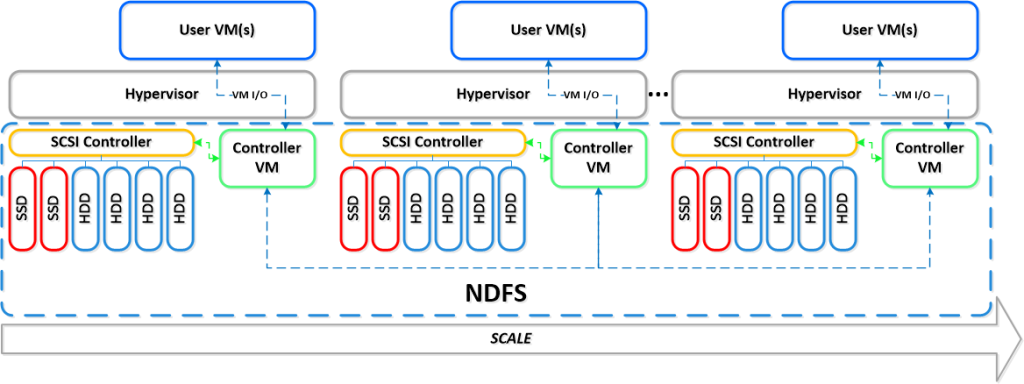
Right now I see Nutanix as the leader here! They rock! Just have a look at this linear scalability:
If you want to learn more how Nutanix can bring great value please contact us at EnvokeIT!
For an intro of Nutanix in 2 minutes have a look at these videos:
Overview:
How to pick virtualization (HW, NW, Storage) solution for your #VDI environment? – #Nutanix, @StevenPoitras
Here we are again… a lot of companies and Solution Architects are scratching their heads thinking about how we’re going to do it “this time”.
Most of you out there have something today, probably running XenApp on your VMware or XenServer hypervisor with a FC SAN or something, perhaps provisioned using PVS or just managed individually. There is also most likely a “problem” with talking to the Storage team that manage the storage service for the IaaS service that isn’t built for the type of workloads that XenApp and XenDesktop (VDI) requires.
So how are you going to do it this time? Are you going to challenge the Storage and Server/IaaS service and be innovative and review the new cooler products and capabilities that now exists out there? They are totally changing the way that we build Virtual Cloud Computing solutions where; business agility, simplicity, cost savings, performance and simple scale out is important!
There is no one solution for everything… but I’m getting more and more impressed by some of the “new” players on the market when it comes to providing simple and yet so powerful and performing Virtual Cloud Computing products. One in particular is Nutanix that EnvokeIT has partnered with and they have a truly stunning product.
But as many have written in many great blog posts about choosing your storage solution for your VDI solution you truly need to understand what your service will require from the underlying dependency services. And is it really worth to do it the old way? You have your team that manages the IaaS service, and most of the times it just provides a way for ordering/provisioning VM’s, then the “VDI” team leverages that one using PVS or MCS. Some companies are not even where they can order that VM as a service or provision it from the Image Provisioning (PVS/MCS) service, everything is manual and they call it a IaaS service… is it then a real IaaS service? My answer would be now… but let’s get back to the point I was trying to make!
This HW, Hypervisor, Network, Storage (and sometimes orchestrator) components are often managed by different teams. Each team are also most of the times not really up to date in terms of understanding what a Virtualization/VDI service will require from them and their components. They are very competent in understanding the traditional workload of running a web server VM or similar, but not really dealing with boot storms from hundreds to thousands of VDI’s booting up, people logging in at the same time and the whole pattern of IOPS that is generated in these VM’s “life-cycle”.
This is where I’d suggest everyone to challenge their traditional view on building Virtualization and Storage services for running Hosted Shared Desktop (XenApp/RDS) and Hosted Virtual Desktop (VDI/XenDesktop) on!
You can reduce the complexity, reduce your operational costs and integrate Nutanix as a real power compute part of your internal/private cloud service!
One thing that also is kind of cool is the integration possibilities of the Nutanix product with OpenStack and other cloud management products through its REST API’s. And it supports running both Hyper-V, VMware ESXi and KVM as hypervisors in this lovely bundled product.
If you want the nitty gritty details about this product I highly recommend that you read the Nutanix Bible post by Steven Poitras here.

#Gartner Magic Quadrant for Cloud Infrastructure as a Service – #IaaS
Market Definition/Description
Cloud computing is a style of computing in which scalable and elastic IT-enabled capabilities are delivered as a service using Internet technologies. Cloud infrastructure as a service (IaaS) is a type of cloud computing service; it parallels the infrastructure and data center initiatives of IT. Cloud compute IaaS constitutes the largest segment of this market (the broader IaaS market also includes cloud storage and cloud printing). Only cloud compute IaaS is evaluated in this Magic Quadrant; it does not cover cloud storage providers, platform as a service (PaaS) providers, software as a service (SaaS) providers, cloud services brokerages or any other type of cloud service provider, nor does it cover the hardware and software vendors that may be used to build cloud infrastructure. Furthermore, this Magic Quadrant is not an evaluation of the broad, generalized cloud computing strategies of the companies profiled.
In the context of this Magic Quadrant, cloud compute IaaS (hereafter referred to simply as “cloud IaaS” or “IaaS”) is defined as a standardized, highly automated offering, where compute resources, complemented by storage and networking capabilities, are owned by a service provider and offered to the customer on demand. The resources are scalable and elastic in near-real-time, and metered by use. Self-service interfaces are exposed directly to the customer, including a Web-based UI and, optionally, an API. The resources may be single-tenant or multitenant, and hosted by the service provider or on-premises in the customer’s data center.
We draw a distinction between cloud infrastructure as a service, and cloud infrastructure as atechnology platform; we call the latter cloud-enabled system infrastructure (CESI). In cloud IaaS, the capabilities of a CESI are directly exposed to the customer through self-service. However, other services, including noncloud services, may be delivered on top of a CESI; these cloud-enabled services may include forms of managed hosting, data center outsourcing and other IT outsourcing services. In this Magic Quadrant, we evaluate only cloud IaaS offerings; we do not evaluate cloud-enabled services. (See “Technology Overview for Cloud-Enabled System Infrastructure” and “Don’t Be Fooled by Offerings Falsely Masquerading as Cloud Infrastructure as a Service” for more on this distinction.)
This Magic Quadrant covers all the common use cases for cloud IaaS, including development and testing, production environments (including those supporting mission-critical workloads) for both internal and customer-facing applications, batch computing (including high-performance computing [HPC]) and disaster recovery. It encompasses both single-application workloads and “virtual data centers” (VDCs) hosting many diverse workloads. It includes suitability for a wide range of application design patterns, including both “cloud-native”….
Figure 1. Magic Quadrant for Cloud Infrastructure as a Service

Source: Gartner (August 2013)
Continue reading here!
//Richard
#Apache #CloudStack grows up – #Citrix, #IaaS – via @sjvn
On June 4th, the 4.1.0 release of the Apache CloudStack Infrastructure-as-a-Service (IaaS) cloud orchestration platform arrived. This is the first major CloudStack release since its March 20th graduation from the Apache Incubator.

It’s also the first major release of CloudStack since Citrix submitted the project to the Apache Foundation in 2012. Apache CloudStack is an integrated software platform that enables users to build a feature-rich IaaS. Apache claims that the new version includes an “intuitive user interface and rich API [application programming interface] for managing the compute, networking, accounting, and storage resources for private, hybrid, or public clouds.”
This release includes numerous new features and bug fixes from the 4.0.x cycle. It also includes major changes in the codebase to make CloudStack easier for developers; a new structure for creating RPM/Debian packages; and completes the changeover to using Maven, the Apache software project management tool.
Apache CloudStack 4.1.0’s most important new features are:
- An API discovery service that allows an end point to list its supported APIs and their details.
- Added an Events Framework to CloudStack to provide an “event bus” with publish, subscribe, and unsubscribe semantics. Includes a RabbitMQ plug-in that can interact with AMQP (Advanced Message Queuing Protocol) servers.
- Implement L3 router functionality for the VMware Nicira network virtualization platform (NVP) plug-in
- Support for Linux’s built-in Kernel-based Virtual Machine (KVM) virtualization with NVP L3 router
functionality. - Support for AWS (Amazon Web Service) style regions
What all this adds up to, according to CloudStack Project Management Committee (PMC) member Joe Brockmeier, is that today’s CloudStack is “a mature, stable project, [that] is also free as in beer and speech. We believe that if you’re going to be building an IaaS cloud for private or public consumption, you’ll be better served choosing an open platform that any organization can participate in and contribute to.”
Brockmeier concluded, “CloudStack is a very mature offering that’s relatively easy to deploy and manage, and it’s known to power some very large clouds–e.g., Zynga with tens of thousands of nodes–and very distributed clouds–such as DataPipe, which…
Continue reading here!
//Richard
OpenStack vs CloudStack: The Latest Score – #CloudStack, #OpenStack
A little update below from Joe Panettieri, good reading! And thanks Oded Nahum for sharing!
And I must agree that I would not count out CloudStack! 😉
OpenStack vs CloudStack: The Latest Score
OpenStack remains the largest and most active open source cloud computing project, Network World notes. But research from Chinese blogger Qingye “John” Jiangsuggests that momentum is building for CloudStack, and interest in Eucalyptus and OpenNebula remains strong. For cloud services providers (CSPs) and consultants, it’s critically important to track each of the four open source cloud platforms. Here’s why.
During Q4 2012, interest in CloudStack grew faster than rival open source cloud platforms. But Jiang’s data shows that:
- OpenStack has the largest total population, followed by Eucalyptus, CloudStack, and OpenNebula;
- OpenStack has the largest active population during the past quarter, followed by CloudStack, Eucalyptus, and OpenNebula;
- OpenStack has the largest active population during the past month, followed by CloudStack, Eucalyptus, and OpenNebula.
Partner Views
Those findings are important to CSPs and consultants that are selecting cloud platforms upon which to build services. OpenStack has been the poster child for open source cloud computing for more than a year now but the bandwagon has some challenges.
Dell, for one, says OpenStack lacks maturity and the hardware giant won’t launch its public cloud (based on OpenStack) for roughly a year. Dell also alleges that Hewlett-Packard’s own public cloud uses a “dramatically forked” version of OpenStack containing proprietary HP technology.
Still, OpenStack consulting opportunities seem to be emerging rapidly. Mirantis, for instance, has emeged as the largest OpenStack systems integrator. The company’s clientele apparently includes Cisco, Dell, GE, Agilent, NASA, HP, AT&T, The Gap, Axcient and Nexenta.
Moreover, Rackspace (NYSE: RAX) continues to see OpenStack progress. CTO John Engates recently offered his perspectives — including some OpenStack milestones — to ZDnet.
Here Comes CloudStack
Meanwhile, it has been awhile since I’ve heard from the CloudStack community. But the CloudStack chatter will likely grow very loud…
Continue reading here!
//Richard
Participating Remotely to OpenStack Summit 2012
“If you can’t make it to San Diego but you still want to participate in the sessions that will shape the future roadmap of OpenStack ‘Grizzly’ you can join the live audio streaming events on Webex. Kindly donated by Cisco Webex team (users of OpenStack themselves), the Webex session will run for the whole day from 9:30am to 6:00pm for each of the rooms Emma AB, Emma C, Windsor BC, Annie AB where the Design Summit will happen. Webex will be used to stream the audio of all conversations in the room where there will be enough microphones: remote participants will use the Webex chat to ask questions and people in the rooms will see the chat stream on one of the two projectors in each room.
The sessions are ready for you to register, they’re identified by topic (Nova, Quantum, Cinder, Documentation, Common, Process, Swift):
- Day 1, Oct 16 Monday https://openstack.webex.com/openstack/onstage/g.php?p=0&t=m
- Day 2, Oct 17 Tuesday https://openstack.webex.com/openstack/onstage/g.php?p=1&t=m
- Day 3, Oct 18 Wednesday https://openstack.webex.com/openstack/onstage/g.php?p=2&t=m
- Day 4, Oct 19 Thursday https://openstack.webex.com/openstack/onstage/g.php?p=3&t=m
Also, each entry on the official schedule of the Design Summit has a link to its proper Webex audio streaming session. There will also be a live video streaming for the general sessions on Tuesday and Wednesday. Keep an eye on the website and twitter for details.
Known issue: Webex doesn’t support Java 64bit on Linux. If you try to join the voip conference Webex will complain that “The Audio Device is Unaccessible Now”. The most common workaround is to install 32bit Java environment alongside the 64bit one.”
Read more here!
//Richard
Don’t Let OpenStack Hype Distort Your Selection of a Cloud Management Platform in 2012
This was an interesting article, I recommend reading it! And thx Ruben for the tip!
“Recommendations:
- Do not plan the future of your data center with the assumption that OpenStack will be at its core. OpenStack may be a promising project, with many vendors eager to join its marketing bandwagon, but its future success is by no means assured. Rather than counting the number of vendors joining the project, judge OpenStack’s progress by its ability to deliver future releases on-time, with the planned features and minimal bugs and achieving mainstream adoption.
- To maximize deployment flexibility and interoperability to enable the potential for multi-vendor substitution, try to choose CMP solutions that allow the layers of the service (access management, service management, service optimization, resource management and the underlying resources), to be logically independent of one another.”
http://www.gartner.com/technology/reprints.do?id=1-1C3IGID&ct=120919&st=sb
//Richard
OpenStack vs. CloudStack – IaaS – PaaS – XaaS
Ok, so what are your thoughts, findings and view on which will become or already is the best solution out there for IaaS/PaaS services?
I must admit that this is not my area of expertise but it’s an area of interest and I like reading about it to get more up to date on where they are from a service readiness perspective. Are they ready for enterprise usage, or are enterprises stuck in their mindset of adopting the open source initiatives and technologies that exists around them. If yes; then why? Is it due to that it doesn’t fit the existing way of how they buy or deliver existing IT services, or is the technology not ready from an ITSM point of view with SD, SLA, SLO and delivery models that we have with the “old” traditional technologies like vSphere, XenServer and Hyper-V if you put a large enterprise organization and governance on top of it?


 The IT Melting Pot!