- Why OpenStack is much more than just hype
- A summary of key OpenStack technologies
- Why to consider converged infrastructure for building private clouds
- The right way to scale-out OpenStack deployments
Watch the webinar here!
//Richard
Everyone talks about the “cloud” and how you can leverage all the benefits or a public, private or hybrid cloud model. And one challenge and huge risks that enterprises see with moving into a public cloud like Azure is the dependency to the public Internet.
Is the connection secure, stable, available and how can you determine that I have the connectivity between my on-premise stuff and Azure..?
It’s here where I think that Microsoft really has made a HUGE step towards getting more traction with the larger enterprises with the new ExpressRoute feature! Now you can get your own dedicated connection to Azure through it’s partner network of service providers like AT&T and Verizon etc.!

Microsoft Azure ExpressRoute lets you create private connections between Azure datacenters and infrastructure that’s on your premises or in a co-location environment. With ExpressRoute, you can establish connections to Azure at an ExpressRoute partner co-location facility or directly connect to Azure from your existing WAN network (such as a MPLS VPN provided by a Network Service Provider). Read more…
Wow! This is interesting! 😀
SAN JOSE, CALIF. – June 24, 2014 – Nutanix, the leading provider of next-generation datacenter infrastructure solutions, today announced it has signed an original equipment manufacturing (OEM) agreement with Dell to offer a new family of converged infrastructure appliances based on Nutanix web-scale technology. The combination of Nutanix’s groundbreaking software running on Dell’s industry-leading servers delivers a flexible, scale-out platform that brings IT simplicity to modern datacenters. The Nutanix and Dell collaboration is designed from the ground up to deliver innovative web-scale technology to enterprises of any size. The agreement also includes joint sales, marketing, support and service investments, as well as alignment of product roadmaps.
The new Dell XC Series of Web-scale Converged Appliances will be built with Nutanix software running on Dell PowerEdge servers, and will be available in multiple variants to meet a wide range of price and performance options. The appliances will deliver high-performance converged infrastructure ideal for powering a broad spectrum of popular enterprise use cases, including virtual desktop infrastructure (VDI), virtualized business applications, multi-hypervisor environments and more. Nutanix’s web-scale software runs on all popular virtualization hypervisors, including VMware vSphere™, Microsoft Hyper-V™ and open source KVM, and is uniquely able to span multiple hypervisors in the same environment. The Dell XC Series appliances are scheduled for availability in the fourth quarter of this year and will be sold by Dell sales teams and channel partners worldwide.
“Nutanix is a recognized leader in the converged infrastructure market with a software-driven offering that fits with Dell’s efforts to redefine datacenter economics and simplify IT for our customers,” said Alan Atkinson, vice president and general manager, Dell Storage. “By combining market-leading infrastructure and software technologies from both companies with Dell’s world-class go-to-market capabilities, we believe our new solutions will be positioned to be a significant player in the growing, multi-billion dollar converged infrastructure market.”
“Dell is a world-class leader in servers, storage and networking, and has established itself as a valuable IT partner for many of the world’s largest organizations,” said Dheeraj Pandey, co-founder and CEO, Nutanix. “Nutanix is teaming with Dell to accelerate our global sales growth through Dell’s vast direct and channel sales networks. In Dell, we chose a company that shares our vision of disrupting traditional datacenter infrastructures with intelligent software running on x86 hardware to power all datacenter services.” Read more…
I’m not surprised at all and think that this is a good report by Gartner!
Nutanix is absolutely the visionary leader and once more and more units are shipped they will also climb higher into the leaders section and totally rule! I must say that this is a really impressive product that truly is web-scale ready for SMB to large enterprise workloads!! Contact us at EnvokeIT if you need more details! We know the product and how it can deliver value to you!
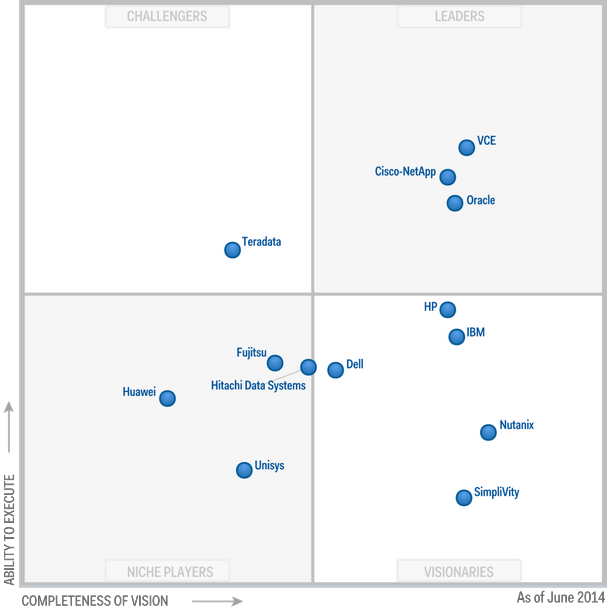
The integrated system market is growing at 50% or more per year, creating an unusual mix of major vendors and startups to consider. This new Magic Quadrant will aid vendor selection in this dynamic sector.
Nutanix has close working relationships with multiple top software vendors, and workloads like VDI, Hadoop and DBMS servers are well-represented among the installed base. Maximum neutrality is a major focus for Nutanix, as it works to build trust across a wide variety of vendors. The vendor frequently targets specific workload needs to penetrate new accounts, and then expands the workload reach to compete with incumbent vendors as client confidence is built. Nutanix claims that 50% of first-time clients expand their configurations within six months (and 70% do so within 12 months).

Integrated systems are combinations of server, storage and network infrastructure, sold with management software that facilitates the provisioning and management of the combined unit. The market for integrated systems can be subdivided into broad categories, some of which overlap. Gartner categorizes these classes of integrated systems (among others):
Read the whole Gartner Magic Quadrant for Integrated Systems here!
//Richard
This is a good post by Dwayne Lessner around how perfect match OpenStack and Nutanix is (not just OpenStack of course, Nutanix rocks with VMware and Microsoft as well)!
Nutanix NDFS also provides an advanced and unique feature set for OpenStack based
private clouds. Key features include:

Read more here.
Here you also have the link to the webinar with topic:
Building OpenStack on a Single 2U Appliance
Watch the webinar here!
//Richard
It’s really great to see the capabilities of the Nutanix platform! Just read this great blog post by @andreleibovici around Content Based Read Cache (CBRC) and how this isn’t necessary at all on a platform like Nutanix!
Conclusion
Overtime I will discuss more about the technology behind Content and Extent Caches. For now what is important to know is that Nutanix provides a better in-memory microsecond latency benefits provided by CBRC for any VDI solution on any of the aforementioned hypervizors, for both Linked and Full-Clones. In fact, Nutanix engineers even recommend Horizon View administrators to disable CBRC because the Nutanix approach is less costly to the overall infrastructure.
It is amazing when your world turns upside down and a technology that used to be awesome becomes mostly irrelevant. It amazes me how fast technology evolves and help organizations to achieve better performance and lower OPEX.
For a long time I have discussed the benefits of CBRC (Content Based Read Cache) available with Horizon View 5.1 onwards, allowing Administrators to drastically cut-down on read IO operations, offloading the storage infrastructure and providing greater end-user experience.
Here are few of the blog posts I wrote on CBRC technology: Understanding CBRC (Content Based Read Cache), Understanding CBRC – RecomputeDigest Method, Sizing for VMware View Storage Accelerator (CBRC), View Storage Accelerator Performance Benchmark, CBRC and Local Mode in VMware View 5.1, View Storage Accelerator (CBRC) Hashing Function.
CBRC helps to address some of the performance bottlenecks and the increase of storage cost for VDI. CBRC is a 100% host-based RAM-Based caching solution that helps to reduce read IOs issued to the storage subsystem and thus improves scalability of the storage subsystem while being completely transparent to the guest OS. However, CBRC comes at a cost.
When the View Storage Accelerator feature (CBRC) is enabled, a per-VMDK digest file is created to store hash information about the VMDK blocks. The estimated size of each digest file is roughly:
The digest file creation for a large replica disk can take a large amount of time and a bulky quantity of IOPS, therefore it’s is recommendable not to run the operation, create new desktop pools, or recompose existing pools during production hours.
CBRC also uses a RAM to manage the cached disk blocks. The per-VMDK digest file is also loaded into memory. That is the reason why CBRC should not be enabled under memory-overcommit environments. If a host is memory over-committed and CBRC is enabled – the memory pressure is increased as CBRC also uses memory for the cache. In such cases, the host could experience increased swapping and the overall host performance could be impacted.
Whilst I wrote about CBRC benefits, I also received numerous negative comments about the technology, including lack of support for full-clone desktops, being unsupported for layering tools like Unidesk, and taking too long to generate new hashes for every replica.
CBRC is a platform feature (vSphere), however it is only enabled and available via Horizon View. Other VDI products such as XenDesktop or vWorkspace cannot utilize the feature.
Nutanix suppress the need for CBCR, providing similar functionality to any VDI solution running on top of vSphere, Hyper-V or KVM. Nutanix has a de-duplication engine built into the solution that works real-time for data stored in DRAM and Flash.

Content Cache (Dynamic Read cache) Read more…
Wow, this is great!
Nutanix Sr. Systems Engineer, Tim Federwitz (@VirtuallyGeeky), created a nice interactive mock-up of the Nutanix Prism Administrative Interface.

In Tim’s own words, “I have created a VERY simple, but somewhat functional, slightly interactive look at the Nutanix Prism GUI (the Nutanix Web Console). You can use it from pretty much any device, including mobile phones and tablets. Click or tap on the various items in the GUI to navigate around the different screen captures. The screenshots are all static, of course, but at least you get to see the different screens and features.
It is still in its infant stage as I threw it together in a few hours last Sunday night. I plan on finishing up the screens I didn’t have time for, but feel free to use it as it comes together. I am “releasing” it early as there seems to be a LOT of interest in something like this.
I really created it to easily show potential customers what the Web Console looks like and highlight some of the features and ease of use that it brings. Along with showing how VM centric and granular…
Continue reading here!
//Richard
Yes, why do people and organisations still think that they can build IaaS/PaaS/DaaS services within their enterprise’s and believe that they will be able to do so with the “same old architecture” and components used before? It’s not going to be comparable to the bigger players that are using newer and more scalable architectures with cheaper components.
Enterprises just don’t have that innovation power that companies like Google, Facebook and Amazon has! And if they do then most of the time they are stuck in their old way of doing things from a service delivery point of view, stopping them from thinking outside of the box though the service delivery organisation isn’t ready for it..
This is a great blog post on this from Brian, great work!!
Last month I wrote that it’s not possible for you to build VDI cheaper than a huge DaaS provider like Amazon can sell it to you. Amazon can literally sell you DaaS and make a profit all for less than it costs you to actually build and operate an equivalent VDI system on your own. (“Equivalent” is the key word there. Some have claimed they can do it cheaper, but they’re achieving that by building in-house systems with lower capabilities than what the DaaS providers offer.)
One of the reasons huge providers can build VDI cheaper than you is because they’re doing it at scale. While we all understand the economics of buying servers by the container instead of by the rack, there’s more to it than that when it comes to huge cloud provider. Their datacenters are not crammed full of HP or Dell’s latest rack mount, blade, or Moonshot servers; rather, they’re stacked floor-to-ceiling with heaps of circuit boards you’d hardly recognize as “servers” at all.
Building Amazon’s, Google’s, and Facebook’s “servers”
For most corporate datacenters, rack-mounted servers from vendors like Dell and HP make sense. They’re efficient in that they’re modular, manageable, and interchangeable. If you take the top cover off a 1U server, it looks like everything is packed in there. On the scale of a few dozen racks managed by IT pros who have a million other things on their mind, these servers work wonderfully!
This is great! A great product takes another award!!! 😉
V3 Readers Award Nutanix with Prestigious Industry Recognition in Highly Competitive Category
Nutanix also won the Best of VMworld 2013 Gold Award for Private Cloud Computing!
LONDON, December 3, 2013 – Nutanix, the leading provider of hyper-efficient, massively scalable and elegantly simple datacentre infrastructure solutions, has been awarded for its continuing innovation in optimising datacentre infrastructure at the V3 Technology Awards 2013. During a ceremony at the Waldorf Hilton Hotel, the company was awarded Best Virtualisation product, beating a host of well respected and larger, more established organisations in the virtualisation market.
V3.co.uk is a leading source of news and analysis for technology professionals, written by a team of expert IT journalists in the UK and Silicon Valley. The awards were hotly contested this year, with more than 450 entries from 150 companies.
“It’s great to see a new company like Nutanix being recognised at the V3 Technology Awards, among the industry giants. It wasn’t an easy task whittling down the hundreds of entries to create the shortlist, and then V3 readers voted in their thousands for their favourites, making this a significant achievement and a well-deserved win. Well done Nutanix!” said Madeline Bennett, Editor, V3 and The INQUIRER.
Alan Campbell, Regional Director of Western Europe at Nutanix, commented on the success: “Nutanix is a company that is constantly innovating and striving to provide the best platform for its customers, so this recognition by a highly respected publication is a testament to the hard work of our team. Virtualisation is a rapidly evolving technology which we are proud to be at the forefront of and to receive an award in the UK, a key market for us, is an honour.
As the fastest growing enterprise…
Continue reading here!
//Richard
Good article and I must agree that OpenStack has quite a long way to go before the “average” enterprise embraces it…
OpenStack still has maturing to do before it’s really ready for the enterprise, analyst says
Network World – Gartner analyst Allessandro Perilli recently attended his first summit for the open source cloud platform OpenStack and he says the project has a long way to go before it’s truly an enterprise-grade platform.
In a blog post reviewing his experience, the analyst – who focuses on studying cloud management tools – says that OpenStack is struggling to increase its enterprise adoption. Despite marketing efforts by vendors and favorable press, enterprise adoption remains in the very earliest stages, he says.
Don’t believe the hype generated by press and vendor marketing: OpenStack penetration in the large enterprise market is minimal.— Gartner analyst Alessandro Perilli
Sure there are examples like PayPal, eBay and Yahoo using OpenStack. But these are not the meat and potatoes types of enterprise customers that vendors are looking to serve. Why? He outlines four reasons, most of which are related to the process and community nature of the project, and less around the technical maturity of it. By the way, this is not the first time a Gartner analyst has thrown cold water on the project.
[EARLIER CRITICISMS FROM GARTNER: Gartner report throws cold water on OpenStack hype]
Lack of clarity about what OpenStack does
There is market confusion about exactly what OpenStack is, he says. It is an open source platform that can be assembled together to build a cloud. It, by itself, is not a cloud though just by downloading and installing it. OpenStack requires some heavy lifting to turn the code into an executable cloud platform, which is why dozens of companies have come out with distributions or productized versions of OpenStack code. But, the code itself is not a competitor to cloud platforms offered by vendors like VMware, BMC, CA or others. Read more…
I must say that Dwayne did a great job with this blog post series!! It goes into expelling the Nutanix Distributed File System (NDFS) that I must say is the most amazing enterprise product out there if you need a truly scalable and agile Compute and Storage platform! I advise you to read this series!!
Under the Covers of a Distributed Virtual Computing Platform – Part 1: Built For Scale and Agility
Lots of talk in the industry about how had software defined storage first and who was using what components. I don’t want to go down that rat hole since it’s all marketing and it won’t help you at the end of the day to enable your business. I want to really get into the nitty gritty of the Nutanix Distributed Files System(NDFS). NDFS has been in production for over a year and half with good success, take read of the article on the Wall Street Journal.
Below are core services and components that make NDFS tick. There are actually over 13 services, for example our replication is distributed across all the nodes to provide speed and low impact on the system. The replication service is called Cerebro which we will get to in this series.

This isn’t some home grown science experiment, the engineers that wrote the code come from Google, Facebook, Yahoo where this components where invented. It’s important to realize that all components are replaceable or future proofed if you will. The services\libraries provide the API’s so as newest innovations happen in the community, Nutanix is positioned to take advantage.
All the services mentioned above run on multiple nodes in cluster a master-less fashion to provide availability. The nodes talk over 10 GbE and are able to scale in a linear fashion. There is no performance degradation as you add nodes. Other vendors have to use InfiniBand because they don’t share the metadata cross all of the nodes. Those vendors end up putting a full copy of the metadata on each node, this eventually will cause them to hit a performance cliff and the scaling stops. Each Nutanix node acts a storage controller allowing you to do things like have a datastore of 10,000 VM’s without any performance impact… continue reading part 1 here.
Under the Covers of a Distributed Virtual Computing Platform – Part 2: ZZ Top
In case you missed Part 1 – Part 1: Built For Scale and Agility

No it’s not Billy Gibbons, Dusty Hill, or drummer Frank Beard. It’s Zeus and Zookeeper providing the strong blues that allow the Nutanix Distributed File System to maintain it’s configuration across the entire cluster. Read more…




 The IT Melting Pot!